



SagaInterop™

Cross-chain messaging with SagaInterop™
Process Document for Blockchain Interoperability
(Public Development Testnet – August 2025)
1. Purpose
This document introduces SagaInterop™, a new level of blockchain interoperability built on SagaChain™.
The goal is to extend beyond token transfers into message-passing and persistent state sharing across blockchains.
SagaInterop is currently in public development testnet and is being introduced as an open framework. We are seeking other chains and developers to participate in shaping its evolution.
Originally developed to address issues that hamper other chains, SagaChain™ completely rethinks how blockchain technology must power data-intensive applications.
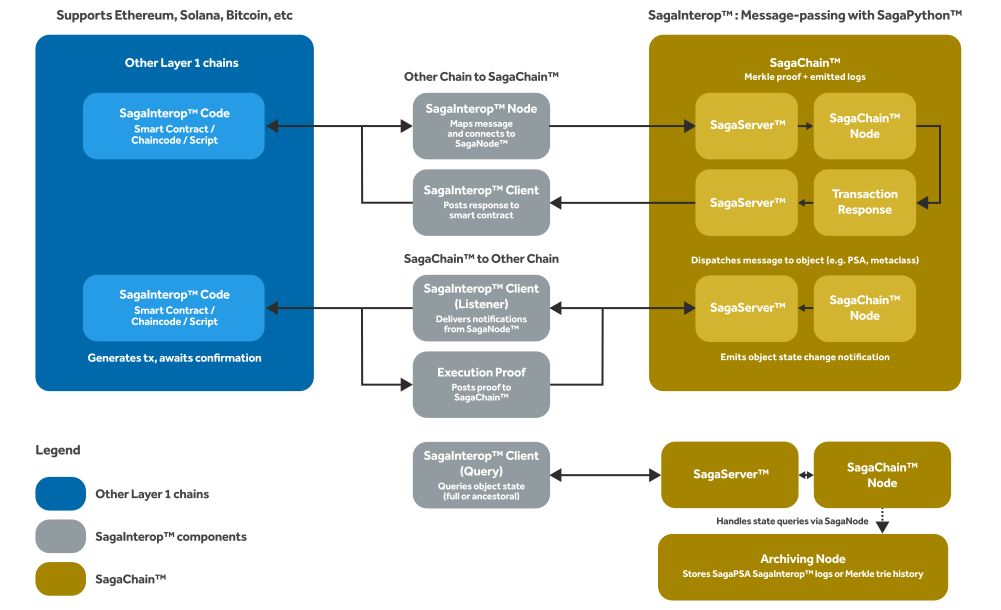
SagaInterop™ architecture

2. Context
SagaChain™ implements Persistent State Data Management (PSDM) through SagaPython™ and the Class Manager Infrastructure (CMI).
SagaInterop™ leverages SagaChain’s message-passing system: All interactions (object methods, state updates, even class creation) are dispatched as messages to objects.
Python syntax hides some details, but under the hood, everything above primitives and control flow is message-based.
Sample SagaInterop™ Contracts have been published to illustrate the concept:
https://code.prasaga.com/sagachain/sagainterop
NB. These are illustrative only, not production-ready.
3. Forward SagaInterop™ Model
3.1 Transaction Lifecycle
3.1.1 Encode Call Data
An external chain writes a SagaPython™ transaction as free text into the call data of a SagaInterop™ smart contract.
3.1.2 SagaInterop™ Node Relay
A SagaInterop™ node monitors the smart contract, reads the call data, and generates a SagaChain™ transaction.
The node decides how the text is mapped into SagaChain message calls.


3.1.3 SagaChain Execution
SagaChain executes the message against the addressed object.
Example: creating a new class is itself a message sent to a metaclass object, even though this is hidden behind Python syntax.
3.1.4 Response + Proof
SagaChain returns:
- A Merkle proof of inclusion in a block
- Any logs from the transaction
3.1.5 Return to External Chain
The SagaInterop™ node posts the result back as a transaction on the originating chain.
4. Reverse SagaInterop™ Model
A SagaInterop™ client registers for updates on SagaChain objects.
SagaChain sends notifications when those objects change.
The SagaInterop™ client generates a smart contract transaction on the external chain.
Once confirmed, the client posts a proof of execution back to SagaChain.
This enables bi-directional, verifiable interoperability.


5. Provenance & Auditability
Future enhancements will support:
SagaInterop™ Logging Classes → Special SagaPSAs to record the history of cross-chain message activity.
Merkle Trie Root History → Enables shard-level auditing by walking backward through account states via archiving nodes.
6. Benefits of SagaInterop™
Provenance → Immutable record of messages & state changes.
Auditability → Merkle proofs & logs for compliance validation.
Ontology → Shared semantics across industries through SagaPSAs & inheritance.
Compliance → Rules enforced by decorators in-flight (e.g., KYC/AML).
Persistent State → Data that survives beyond transactions, accessible across chains.


7. Development Roadmap
Public Development Testnet live
Sample SagaInterop™ code repo available (illustrative only): https://code.prasaga.com/sagachain/sagainterop
Forward SagaInterop™ transactions being implemented
Object state retrieval (full + ancestor-specific) in design
Reverse SagaInterop™ notifications
SagaInterop™ Logging Classes + Merkle trie history planned
8. Conclusion
SagaInterop™ introduces a new level of blockchain interoperability:
Not just token transfers, but message-passing and object state integration.
Verifiable, auditable, persistent.
Available now in public development testnet.
Supported with illustrative sample code to spark collaboration.
SagaChain™ invites other blockchains and developers to join in building this framework.
Together, we can extend the internet into a stateful, message-driven fabric of interoperable blockchains.


Current sampled interoperability code:
Bitcoin
Cardano
Ethereum
MultiversX
Near
Sui
Aptos
Avalanche
Hyperledger
Solana