



Industries ▸ Finance
Class Tree

Financial Global Class Tree
An Initiative to Unify Global Financial Standards and Regulatory Frameworks on SagaChain™
Research/Draft Prepared By: ChatGPT 5.0, Grok 4.0
Reviewed By: Michael Holdmann, David Beberman, Rich Phillips
Abstract
The SagaFinance™ under the umbrella of SagaStandards™, is a effort to unify financial standards and regulatory frameworks into a single-instance, multi-inheritable class tree on SagaChain™. Building on decades of work by standards bodies (ISO, FIX, XBRL, FIGI, FIBO, ISDA) and regulators (SEC, FRB, OCC, FDIC, CFPB, OFAC, and others), SagaFinance™ encodes these frameworks as persistent SagaPython™ classes. This transforms them from static specifications into living, interoperable code that operates on a decentralized, permissionless Layer 1 blockchain.
“The initial seeding of the SagaFinance™ Tree and all implemented ALPHA code was completed solely by PraSaga Foundation as a gift to the stakeholders and customers of the real estate industry. This effort is not affiliated with any other Standards Development Organization, Government or Regulatory Agency.
All code was generated from Open Public Machine-Readable sources using both ChatGPT 5.0 and Grok AI platforms to retrieve and convert XML, OWL, JSON, PDF, RDF, CSV, and similar documents into SagaPython™ Classes.
This document research and draft was prepared by the AI platform that generated the respective code and mapped the ontologies, it was reviewed by the PraSaga Foundation team for editing/correction of blatant hallucinations. The validation of the architecture and ontologies is now ready for stakeholders to review and update.”
The initiative is designed as a public good:
- For industry, it eliminates reconciliation costs and reduces vendor lock-in.
- For governments and regulators, it enables real-time oversight with privacy-preserving compliance.
- For standards bodies (SDOs), it ensures faithful, canonical execution of their schemas.
- For consumers, it guarantees transparency, trust, and protection.
As a SagaStandards™ initiative, SagaFinance™ is governed by an open membership model, actively recruiting participants from governments, industry consortia, regulators, and other SDOs to take custodianship of SagaFinance™, and maintain. By aligning with both technical innovation and institutional governance, SagaFinance™ positions SagaChain™ as the first global financial infrastructure standard, interoperable by design and stabilized by the SagaCoin™ management model.
1. Background & Motivation
1.1 Fragmented Landscape of Financial Standards
The global financial system reflects decades of incremental standardization:
- ISO 20022 unifies payments messaging across borders.
- FIX Protocol powers electronic trading in equities, FX, and derivatives.
- XBRL enables machine-readable financial reports.
- FIGI provides universal instrument identifiers.
- FIBO introduces semantic ontologies for finance.
- ISDA CDM harmonizes derivatives lifecycle events.
- SEC filings enforce disclosure frameworks.
Each standard succeeded in its context, but together they form islands of compliance. A trade initiated in FIX must be reconciled into ISO settlement, tied to a FIGI identifier, disclosed via XBRL, and filed with the SEC each step siloed, costly, and prone to error.
1.2 Historical Attempts at Unification
Efforts to unify standards have typically centered on messaging hubs (e.g., SWIFT’s ISO 20022 migration) or regulatory APIs (e.g., XBRL in SEC EDGAR). These reduce friction but fail to resolve the deeper architectural problem:
- Centralized infrastructure: Single points of failure, subject to political or commercial control.
- State discontinuity: Each system maintains separate ledgers and schemas, requiring endless reconciliation.
The result: better “pipes” but no shared “well.”
1.3 Why Fragmentation Continues
The core issue is architecture. Traditional IT systems and first-generation blockchains lack persistent, global object state.
- Databases replicate but do not share execution semantics.
- APIs connect but do not inherit behaviors.
- Blockchains record transactions but are stateless contracts and UTXOs reset each time, losing persistent context.
This forces interoperability to mean translation, not true inheritance or composability.
1.4 SagaChain™: Persistence as First-Class Principle
SagaChain™ introduces a persistent object model where standards are classes, instantiated as live objects in a single-instance global class tree.
Key innovations:
- Persistent Objects: Classes survive across blocks, retaining state.
- Multi-Inheritance: A single object can be both a FIXOrder and an ISO20022Payment.
- Late Binding: Behaviors resolve dynamically, enabling polymorphism across domains.
- Account Ownership & Sharding: Accounts are objects, enabling SagaScale™ to move workloads elastically.
- Global Object IDs: Each object is globally referenceable, ensuring no broken links.
1.5 Implications
If each standard becomes a SagaPython™ class:
- ISO 20022 messages are objects with decorators validating fields.
- FIX trades inherit ISO settlement and FIGI identity automatically.
- XBRL disclosures become methods referencing live trades.
- SEC filings are composite objects linking reporting, identifiers, and trades.
- ISDA swaps execute privately in enclaves but anchor public proofs.
This eliminates reconciliation, accelerates regulatory oversight, and embeds compliance directly into business logic.
1.6 Motivation for the Initiative
The Financial Class Tree is not about reinventing standards. It is about faithfully encoding them into a persistent, multi-inheritable system.
Motivations include:
- Remove reconciliation overhead.
- Provide regulators with live compliance data.
- Enable consumer transparency.
- Achieve scale and privacy with SagaScale™ and Private Enclaves.
- Guarantee interoperability through SagaInterop™.
In essence: turn standards into living code, not static documents.
2. SagaChain™ Technology Foundation
Overview
This section delineates the operational framework that renders a single-instance global financial class tree viable at industrial scale. SagaChain™ transforms standards and regulatory frameworks into persistent, multi-inheritable objects, distinguishing itself structurally from first-generation blockchains or conventional middleware systems.
2.1 SagaPython™: Native Language for Persistent Finance
SagaPython™ constitutes a Python dialect tailored for blockchain environments. In contrast to Solidity, which employs contract-centric state management, or Move, which supports global resources but eschews multi-inheritance, SagaPython™ retains Python’s accessibility while incorporating blockchain-native semantics via the Class Manager Infrastructure (CMI).
Key innovations in SagaPython™ include:
- Persistent Classes: The `@sagaclass()` decorator registers a class definition within the Global Class Registry (GCR), enabling instantiation as persistent objects managed by SagaOS™.
- Validated Fields: The `sagafield()` construct enforces data types and access control.
- Behavioral Methods: The `@sagamethod()` decorator defines methods with embedded compliance checks.
- Inheritance: Classes support inheritance across standards (e.g., ISO + FIX + SEC).
- Late Binding: Behaviors resolve dynamically within inheritance hierarchies.
Example: Settlement Instruction
@sagaclass()
class SettlementInstruction(SPClassObject):
 txn_id: str = sagafield()
 amount: float = sagafield()
 ccy: str = sagafield(length=3)
 debtor: str = sagafield()
 creditor: str = sagafield()

 @sagamethod()
 def validate(self):
 assert self.amount > 0 and len(self.ccy) == 3
Code language: 1C:Enterprise (v7, v8) (1c)
These features enable industry practitioners to leverage existing Python proficiency, while regulators benefit from compliance-by-design, and standards development organizations (SDOs) achieve faithful schema execution in code.
2.2 SagaOS™: The On-Chain Operating System
2.2.1 Rationale and role in the stack
Most blockchains provide a transaction virtual machine but lack an operating system for managing persistent objects, namespaces, versioning, account negotiation, and message passing as primitive operations. SagaOS™ addresses this deficiency as the on-chain operating system of SagaChain™, ensuring that every standard class (e.g., ISO 20022, FIX, XBRL) and regulatory class (e.g., SEC, FRB, OCC) resides in a canonical runtime with uniform execution semantics.
2.2.2 Core subsystems
- Global Class Registry (GCR): Maintains a canonical catalog of all `@sagaclass()` definitions, preventing schema duplication and supporting version lineage (e.g., `ISO20022_Pacs008_v2` extends`ISO20022_Pacs008_v1`).
- Persistent Object Store (POS): Provides durable storage for object instances, addressed via Object IDs (OIDs) that persist across blocks and shards.
- Deterministic Message Bus (DMB): Facilitates object-to-object `@sagamethod()` invocations by OID, with deterministic ordering and replay guarantees.
- Sharded Scheduler (SS): Manages account negotiation cycles to allocate ownership across shards, enabling parallel execution without cross-shard data synchronization (see §2.5).
- Version & Policy Manager (VPM): Oversees class evolution, deprecation, and policy hooks (e.g., regulator-mandated validations executed pre- or post-method).
2.2.3 Execution Semantics and Contrasts
Persistent objects differ from smart contracts, which maintain aggregate persistent state but lack granular object-level persistence: EVM-style systems feature isolated, stateful contracts but lack integration into a global, versioned class tree. SagaOS™ unifies state, inheritance, and policy execution.
Method invocations via DMB ensure causal ordering for intra- and inter-shard communications. Routing occurs by OID, with the scheduler providing at-least-once delivery; idempotent method designs are recommended.
2.2.4 Example: OS-level process and signals
@sagaclass()
class OS_Process(SPClassObject):
 pid: str = sagafield()
 owner_oid: str = sagafield()
 state: str = sagafield(enum={"Running", "Suspended", "Completed"})

 @sagamethod()
 def send_signal(self, signal: str)

# Kernel-enforced policy hooks may intercept
 assert signal in {"SUSPEND", "RESUME", "STOP"}

self.state = {"SUSPEND": "Suspended", "RESUME": "Running", "STOP": "Completed"}[signal]

```
Code language: 1C:Enterprise (v7, v8) (1c)
This subsystem yields framework-level assurances (namespaces, policy execution) that minimize bespoke infrastructure for industry, enable compliance-by-design at method boundaries for regulators, and provide a canonical runtime for SDO-maintained standards.
2.3 SagaPSA™: Programmable Smart Assets (beyond contracts)
2.3.1 Concept
A SagaPSA™ represents a long-lived financial object capable of simultaneous inheritance from multiple standards and regulatory classes. The object encapsulates its lifecycle—from order to execution, payment, disclosure, and supervision—without data copying or translation.
2.3.2 Invariants, lifecycle, and policy hooks
Invariants are specified via `@sagamethod()` assertions or `sagafield()` constraints. Lifecycle methods (e.g., `fill()`, `settle()`, `file_10K()`) mutate the object in place. Policy hooks, managed by SagaOS™ VPM, enforce regulator-required checks atomically with business logic.
2.3.3 Example: Trade-to-Settlement-to-Disclosure in one object
@sagaclass()
class EquityTradePSA(FIXOrder, FIXExecutionReport, ISO20022_Pacs008, FIGIIdentifier):
 trade_date: str = sagafield(pattern=r"\d{4}-\d{2}-\d{2}")
 status: str = sagafield(enum={"New", "Filled", "Settling", "Settled"})

 @sagamethod()
 def fill(self, last_qty: int, last_px: float):
 self.exec_type = "Trade"
 self.last_qty = last_qty
 self.last_px = last_px
 self.status = "Settling"

 @sagamethod()
 def create_payment(self, debtor_acct: str, creditor_acct: str, ccy: str = "USD"):
 amt = (self.last_qty or 0) * (self.last_px or 0.0)
 self.instructed_amt = amt
 self.debtor_acct = debtor_acct
 self.creditor_acct = creditor_acct
 self.ccy = ccy

 @sagamethod()
 def settle(self):
 assert self.instructed_amt and self.debtor_acct and self.creditor_acct
 self.status = "Settled"
Code language: 1C:Enterprise (v7, v8) (1c)
This approach eliminates extract-transform-load (ETL) pipelines for industry, provides a continuous audit trail via one OID for regulators, and renders standards executable for SDOs.
2.4 The Global Single-Instance Class Tree
2.4.1 Canonical namespace and conflict-free evolution
The Global Class Tree enforces one authoritative class definition worldwide. Conflicts resolve through versioned inheritance rather than semantic forks.
@sagaclass()
class ISO20022_Pacs008_v1(SPClassObject):
 message_id: str = sagafield()

@sagaclass()
class ISO20022_Pacs008_v2(ISO20022_Pacs008_v1):
 service_level: str = sagafield(optional=True, enum={"SEPA", "URGENT", "STD"})
Code language: 1C:Enterprise (v7, v8) (1c)
2.4.2 Referential integrity and identity graph
OIDs are globally unique, enabling cross-shard and cross-chain references (§2.6). Entities (e.g., issuers, banks) are modeled as `SPClassAccount` instances owning objects; relationships (e.g., LEI hierarchies) appear as first-class edges.
@sagaclass()
class ClassBusinessAccount(SPClassAccount):
 lei: str = sagafield(length=20)
 legal_name: str = sagafield()

@sagaclass()
class OwnershipEdge(SPClassObject):
 parent_lei: str = sagafield(length=20)
 child_lei: str = sagafield(length=20)
 pct: float = sagafield()
Code language: 1C:Enterprise (v7, v8) (1c)
2.4.3 Governance and SDO participation
Change proposals manifest as class differentials; SDOs curate namespaces. Compatibility prioritizes additive modifications; breaking changes necessitate versioned subclasses with migration methods.

This structure precludes schema duplication for industry, preserves audit lineage for regulators, and offers SDOs a governed transition from specifications to executable classes.
2.5 SagaScale™ Dynamic Sharding
2.5.1 Design goals
SagaScale™ attains scalability through execution sharding, wherein non-conflicting transactions—those modifying disjoint sets of account objects—execute in parallel across independent shard chains. Throughput escalates with shard proliferation, dynamically calibrated to latency signals, without data sharding or attendant cross-shard communications. Conflicts arise solely from concurrent modifications to shared accounts; resolution via pre-execution negotiation ensures atomic, synchronous execution within shards, fostering composability through stable object IDs.
2.5.2 Co-location and migration policy
SagaChain™’s account-oriented model situates all state in objects instantiating from metaclasses descending from root `SPClassObject`. Accounts, subclasses of `SPClassAccount`, delineate parallelism: non-account objects reference a sole owning account via a mutable field, with ownership transitive through references. Relative to shards, accounts assume owned (modifiable exclusively by one shard), unowned (transaction-inert), or readonly (multi-shard readable if globally unmodified) states.
Invariants preclude conflicts:
– Modifications target owned accounts within the shard.
Negotiation cycles five stages: (1) per-transaction account identification (explicit headers or trial execution); (2) request formulation; (3) assignment/release consensus; (4) pending transfer designation; (5) transfer finalization. This supplants cross-shard yanking—eschewing Ethereum’s abandoned clustering attempts—with ownership transitions, preserving OID stability for deterministic messaging and inheritance.
2.5.3 Cross-shard call semantics
Shard leaders submit ranked tuples of requests—acquisitions for modifiable accounts (`MAi`) and readonly (`RAj`), disjoint within tuples—to the negotiator, valued by local `V()` (e.g., transaction volume × fees). Inputs aggregate as `AcqReq = {∀Shard ∈ {{Acq(MA1, …, MAn), RO(RA1, …, RAm)}, …}}`; outputs as `AcqAsgn = {∀Shard ∈ {{PendAcq(MA1, …, MAn), PendRel(PRA1, …, PRAm)}} ∧ {PendRO(PROA1, …, PROAp)}}`, barring intra-shard acquisition/release overlaps or acquisition/readonly intersections.
Objectives optimize:
– **Objective 1**: Maximize satisfied tuples (`Max(∑_{shards} ∑_{tuples} 1)`).
– **Objective 2**: Minimize transfers (`Min(∑ (MAi = PRAi))`).
– **Objective 3**: Maximize valuation (`Max(∑_{shards} ∑ V(tuples))`).
The NP-complete search—blending set packing (exclusive modifications) and set cover (shared readonly)—spans shards × tuples (e.g., 100 × 256 = 25,600). Conflicts manifest in cross-shard modifiable overlaps or exclusivity breaches.
PSAA, a bounded randomized greedy traversal, shuffles shards iteratively (≤ M runs), constructing a directed graph of non-conflicting assignments:
1. Seed dummy vertex.
2. Per shard, extend via four criteria, yielding children:
- PreviousReadonlyOverModified & PreviousModifiedOverReadonly: Retains prior readonly/modifiable precedence.
- ModifiedOverPreviousReadonly & ReadonlyOverPreviousModified: Evicts priors for new modifiable/readonly.
- ModifiedOverPreviousReadonly & PreviousModifiedOverReadonly: Evicts for new modifiable; rejects new readonly conflicts.
- PreviousReadonlyOverModified & ReadonlyOverPreviousModified: Rejects new modifiable conflicts; evicts for new readonly.
- Tuples evict/add holistically on conflicts.
3. Heuristically prune to top-4 vertices (16 candidates) via valuation weights.
4. Escalate maximum; bound stalls by failure counts.
5. Emit highest vertex as solution, verifiable polynomially.
2.5.4 Shard Leader Identification and Selection
Leaders curate tuples via batched queuing: explicit-header transactions enqueue directly; others stratify by primary account ownership, trialing owned high-fee subsets first, then random samples from remote/unowned. Outputs cluster as `{∀ PAi ∧ {SA1, …, SAp} ∧ {RO1, …, ROq}}`, ranked by value. Covered tuples ready for blocks; others pend negotiation or evict on remote execution. Randomization curbs inter-leader trial redundancy sans coordination.
2.5.5 The PraSaga Conjecture
PSAA leverages the PraSaga Conjecture: within bounded durations (e.g., minutes), transaction cohorts exhibit non-random account clusters (`SAi`), with reuse probability surpassing uniform selection (`P(SAi) > P(RSAi)`). Social/economic affinities—e.g., shopper-store recurrences or market non-random walks—induce probabilistic determinism, mirroring multicore thread affinity sans thrashing. Cluster assignments enable burst-parallelism, elevating capacity; conjecture absence yields valid random baselines, but realization curtails transfers, amplifying SagaScale’s efficacy.
2.5.6 Economic Layer: SagaCoin
SagaCoin™ denominates flat per-operation fees and storage rent, accruing to validators. Negotiation subsidies incentivize parallelism, with supply dynamics stabilizing purchasing power amid escalating demand.

SagaScale™ ensures capacity predictability for industry, observability under stress for regulators, and scalability proofs for SDOs.
2.6 SagaInterop™: Cross-Chain Interoperability
2.6.1 Philosophy
SagaInterop™ positions SagaChain™ as a compliance anchor for heterogeneous ledgers, referencing external states without assuming state-issued digital currencies.
2.6.2 Outbound and Inbound Paths
Outbound: A SagaPSA™ emits an `InteropEvent` with state commitment; a relay on the target chain verifies via Merkle proof and materializes a reference.
Inbound: External proofs update local mirror objects on SagaChain™.
@sagaclass()
class InteropEvent(SPClassObject):
 event_id: str = sagafield()
 src_chain: str = sagafield()
 proof: str = sagafield()
 payload: dict = sagafield()

 @sagamethod()
 def verify_and_apply(self, target_oid: str):

 # Verify proof-payload correspondence, then mutate target
 pass
Code language: 1C:Enterprise (v7, v8) (1c)
2.6.3 Asset exchange with SagaCoin
SagaCoin™ serves as a neutral medium for cross-chain flows, tying provenance to one SagaChain™ OID.
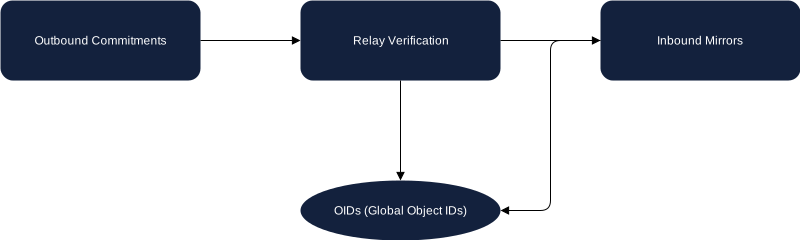
This enables interoperability for industry, verifiable lineage for regulators, and standard portability across environments for SDOs.
2.7 SagaFeeds™: Public verified source Indexing
2.7.1 Motivation
SagaFeeds democratizes compliance metadata (filings, settlements, instruments).
2.7.2 Index classes and composition
Indices are SagaPython™ classes mapping keys to OID lists.
@sagaclass()
class IndexByLEI(SPClassObject):
 lei: str = sagafield()
 obj_ids: list = sagafield()

 @sagamethod()
 def add(self, oid: str):
 if oid not in self.obj_ids:
 self.obj_ids.append(oid)

@sagaclass()
class IndexByFIGI(SPClassObject):
 figi: str = sagafield()
 obj_ids: list = sagafield()
Code language: 1C:Enterprise (v7, v8) (1c)
2.7.3 Query semantics and performance.
Reads incur no gas; updates are append-only via business methods.
2.7.4 Privacy alignment
Indices reference OIDs only; sensitive data resides in objects (enclave-protectable, §2.8).

SagaFeeds™ reduce data costs for industry, enable intermediary-free transparency for regulators, and enhance taxonomy discoverability for SDOs.
2.8 Private Enclaves: Confidential Finance with Public Proofs
2.8.1 Problem statement
Financial operations require balancing transparency for oversight with confidentiality for proprietary or personal data; public ledgers alone suffice for neither.
2.8.2 Enclave model
Private Enclaves nodes can be run in TEE-backed environments on SagaChain™, integrating trusted execution environments (e.g., Intel SGX, AMD SEV) into the sharded architecture:
- Encryption in use during computation..
- Remote attestation for code and data integrity.
- Selective disclosure of aggregates or proofs.
Classes are marked for enclave execution, outputting proofs or aggregates.
@sagaclass()
class Enclave_RiskModel(SPClassObject):
 model_id: str = sagafield()
 encrypted_payload: bytes = sagafield()

 @sagamethod()
 def compute_and_attest(self) -> str:

 # Secure computation; return attestation reference
 return "attest:sha256:…"
Code language: 1C:Enterprise (v7, v8) (1c)
2.8.4 Patterns of use
- Derivatives netting: Private exposures yield attested margins.
- KYC/AML: Sensitive screens produce pass/fail proofs
- Pre-disclosure: Confidential XBRL drafts yield compliant aggregate
2.8.5 Interplay with SagaFeeds™ and Interop
Indices point to proof OIDs; external chains verify via SagaInterop™.

Enclaves protect intellectual property for industry, assure computations for regulators, and allow standards to specify proof types for confidential elements.
2. Conclusion
SagaChain™ integrates SagaOS™, SagaPSA™, the Global Single-Instance Class Tree, SagaScale™, SagaInterop™, SagaFeeds™, and Private Enclaves into a compliance-grade runtime where standards and regulations execute as code. SagaCoin™ facilitates execution fees, inter-chain exchange, and purchasing-power stabilization.
This architecture establishes the foundational layer for a single-instance global financial system that is interoperable, auditable, scalable, and privacy-preserving by design.
3. Standards Class Trees
Overview
The Financial Class Tree Initiative encodes global standards not as static schemas, but as persistent SagaPython™ classes. This section details the six foundational standards ISO 20022, FIX, XBRL, FIGI, FIBO, and ISDA CDM and demonstrates how they are represented within SagaChain™. Each subsection explores (1) historical context, (2) design limitations, (3) the SagaPython™ class representation, (4) integration with SagaScale™, SagaInterop™, SagaFeeds™, and Private Enclaves, and (5) implications for industry, regulators, and standards bodies.
3.1 ISO 20022: Universal Payments Messaging
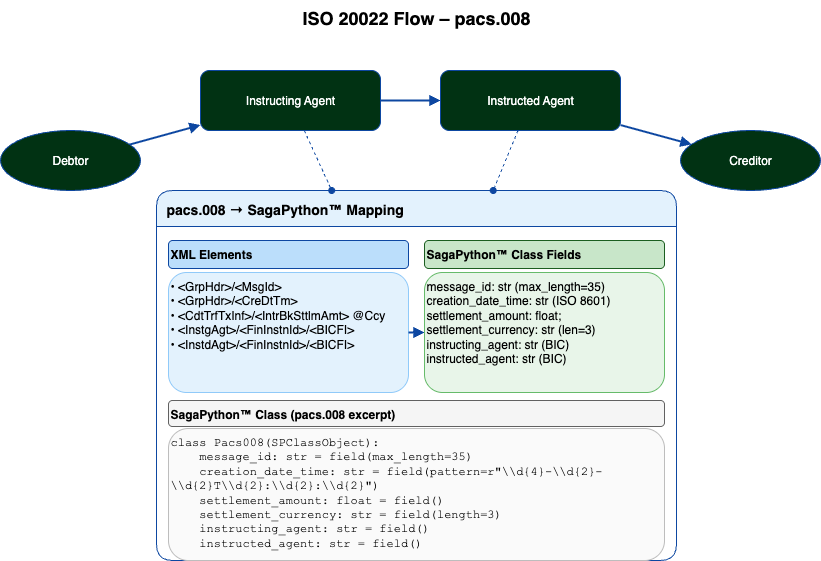
ISO 20022 has become the global standard for electronic payments messaging, mandated by SWIFT and adopted across dozens of central and commercial banks. Its XML-based schemas (e.g., pacs.008 for credit transfers) enable structured data exchange but require constant reconciliation with trading, settlement, and reporting systems.
SagaChain™ Encoding
On SagaChain™, ISO messages are no longer transient XML documents but persistent class objects:
@sagaclass()
class ISO20022_Pacs008(SPClassObject):
 msg_id: str = sagafield()
 txn_id: str = sagafield()
 debtor: str = sagafield()
 creditor: str = sagafield()
 amount: float = sagafield()
 currency: str = sagafield(length=3)

 @sagamethod()
 def validate(self):
 assert self.amount > 0 and len(self.currency) == 3
Code language: 1C:Enterprise (v7, v8) (1c)- SagaScale™: Credit transfers scale across shards, while related debtor/creditor accounts are co-located.
- SagaInterop™: ISO payments can trigger settlement contracts on Ethereum or Solana, verified with Merkle proofs.
- SagaFeeds™: Regulators query all ISO20022_Pacs008 instances by debtor, creditor, or date.
- Private Enclaves: Sensitive payment metadata (e.g., counterparty bank routing) may remain private while proofs confirm validity.
Implications
- Industry: Eliminates middleware translation layers between ISO and local standards.
- Regulators: Real-time systemic liquidity monitoring becomes possible.
- SDOs: ISO schemas are preserved exactly, ensuring fidelity while extending interoperability.
3.2 FIX Protocol: Trading Communication
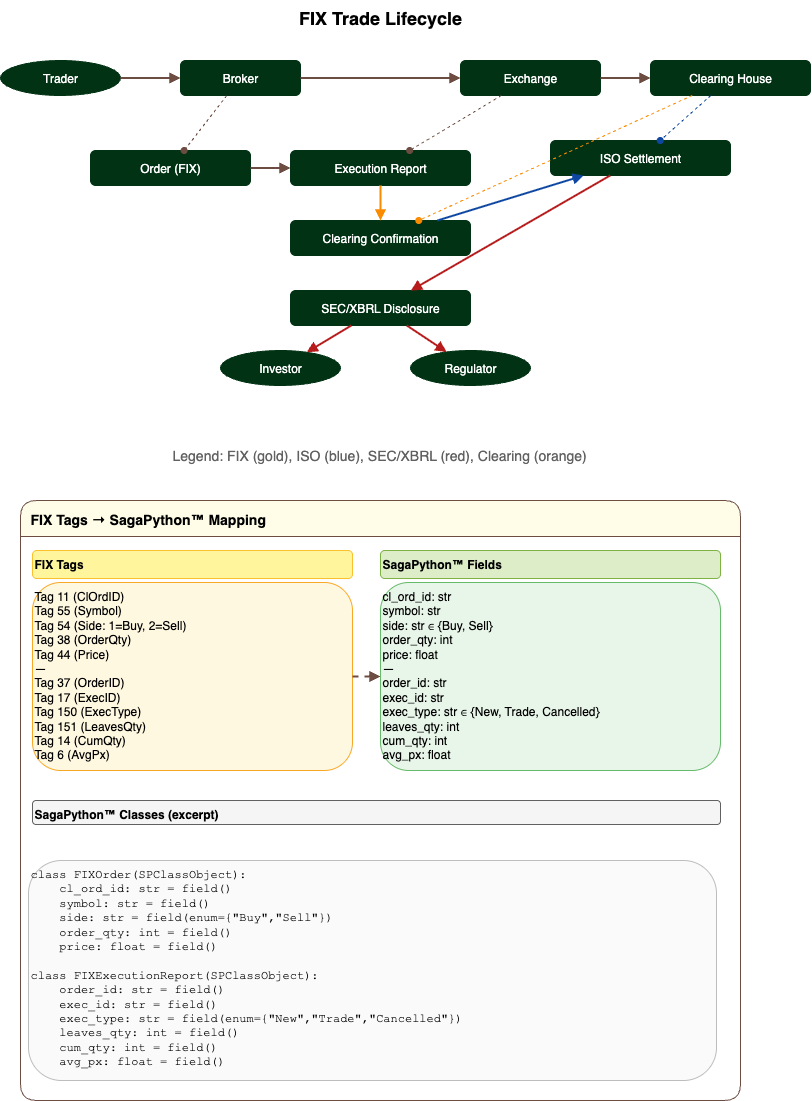
The FIX Protocol has underpinned electronic trading since the 1990s. Its tag-based message system is efficient but brittle, requiring manual reconciliation with downstream standards.
SagaChain™ Encoding
SagaPython™ classes replace ad hoc tags with typed fields:
@sagaclass()
class FIXOrder(SPClassObject):
 cl_ord_id: str = sagafield()
 symbol: str = sagafield()
 side: str = sagafield(enum={"Buy","Sell"})
 qty: int = sagafield()
 price: float = sagafield()

 @sagamethod()
 def execute(self):
 self.status = "Executed"
Code language: 1C:Enterprise (v7, v8) (1c)- SagaScale™: targets billions of daily operations with predictable fees.
- SagaInterop™: FIX trades reference ISO payments, ensuring seamless front-to-back integration.
- SagaFeeds™: Public indices enable regulators to monitor order flow.
- Private Enclaves: Execution algorithms may remain confidential, exposing only execution proofs.
Implications
- Industry: Direct linkage from trade to settlement to disclosure.
- Regulators: Transparency into systemic trading risks.
- SDOs: FIX tags persist but are enriched with persistent object semantics.
3.3 XBRL: Machine-Readable Reporting
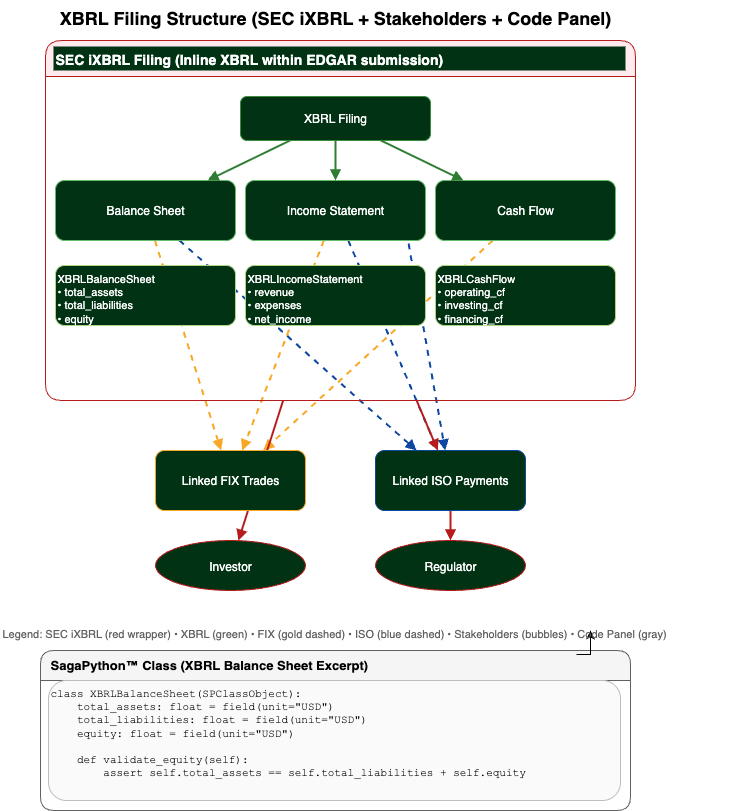
XBRL is the backbone of machine-readable corporate financial reporting. Yet in practice, it is implemented as static XML filings uploaded to regulators, divorced from real-time financial activity.
SagaChain™ Encoding
In SagaChain™, XBRL filings are live class objects:
@sagaclass()
class XBRLBalanceSheet(SPClassObject):
 assets: float = sagafield()
 liabilities: float = sagafield()
 equity: float = sagafield()

 @sagamethod()
 def validate_balance(self):
 assert self.assets == self.liabilities + self.equity
Code language: 1C:Enterprise (v7, v8) (1c)- SagaScale™: Filings scale with billions of line items across issuers.
- SagaInterop™: XBRL classes integrate with ISO and FIX, ensuring disclosures reference actual trades and payments.
- SagaFeeds™: Permanent indices of filings ensure investors and regulators have real-time access.
- Private Enclaves: Proprietary draft data may remain private until formally disclosed.
Implications
- Industry: Reduces reconciliation between internal ledgers and external filings.
- Regulators: Eliminates lag between events and disclosures.
- Consumers: Direct access to trusted, real-time disclosures.
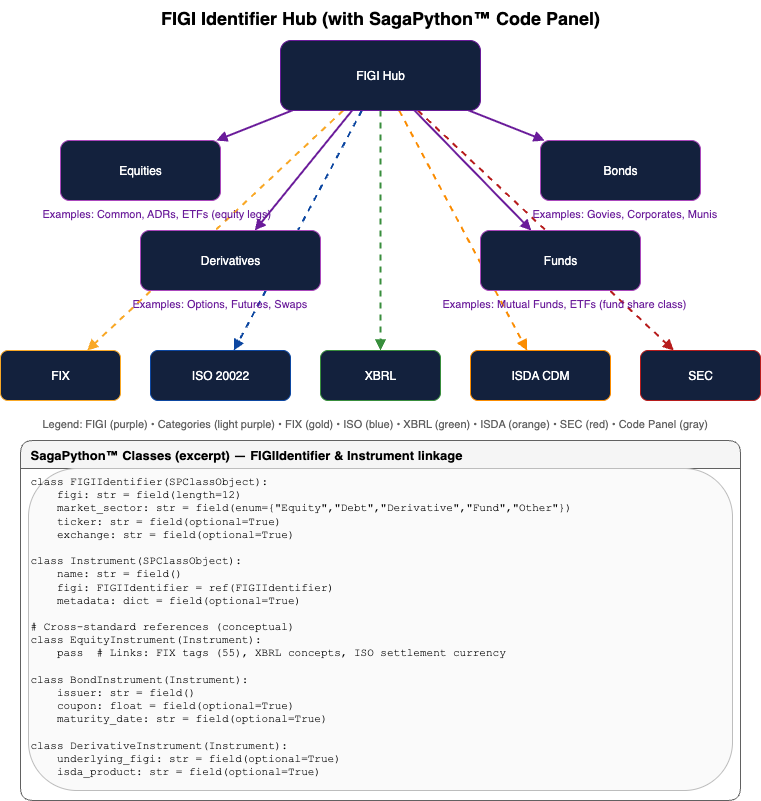
3.4 FIGI: Instrument Identifiers
Bloomberg’s Financial Instrument Global Identifier (FIGI) is widely used to uniquely identify instruments. Its adoption solved fragmentation but remains a reference-only system.
SagaChain™ Encoding
On SagaChain™, FIGIs are live identifiers:
@sagaclass()
class FIGIIdentifier(SPClassObject):
 figi: str = sagafield(pattern=r"[A-Z0-9]{12}")
 instrument_type: str = sagafield()
Code language: 1C:Enterprise (v7, v8) (1c)- SagaScale™: Billions of FIGIs persist and link across shards.
- SagaInterop™: FIGIs anchor cross-chain instruments.
- SagaFeeds™: Public FIGI lookups provide verification.
- Private Enclaves: Proprietary mappings (e.g., structured products) can remain private.
Implications
- Industry: Eliminates disputes over instrument identity.
- Regulators: Systemic aggregation across asset classes.
- SDOs: Extends FIGI utility as a live compliance anchor.
3.5 FIBO: Ontology of Finance
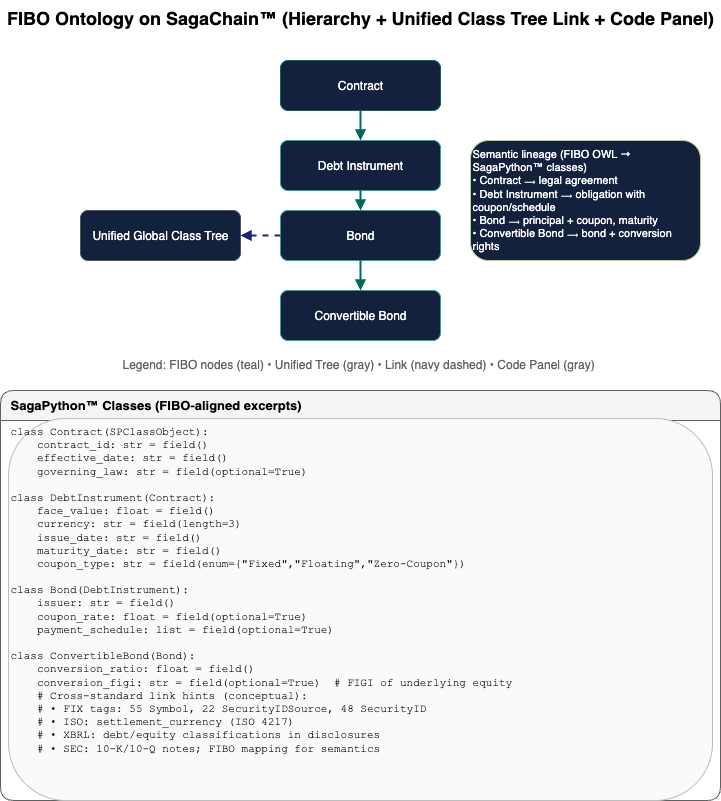
The Financial Industry Business Ontology (FIBO) provides semantic models for finance, but adoption has been limited due to complexity.
SagaChain™ Encoding
FIBO concepts become executable classes:
@sagaclass()
class FIBOContract(SPClassObject):
 contract_id: str = sagafield()
 party_a: str = sagafield()
 party_b: str = sagafield()
 governing_law: str = sagafield()
Code language: 1C:Enterprise (v7, v8) (1c)- SagaScale™: Semantic contracts scale across billions of entities.
- SagaInterop™: Legal terms can be anchored across blockchains.
- SagaFeeds™: Indicies allow ontology-driven risk queries.
- Private Enclaves: Confidential contracts can publish compliance proofs without revealing terms.
Implications
- Industry: Automated reasoning across complex portfolios.
- Regulators: Ontology-driven surveillance and systemic oversight.
SDOs: FIBO realized as living, persistent code.
3.6 ISDA CDM: Derivatives Lifecycle
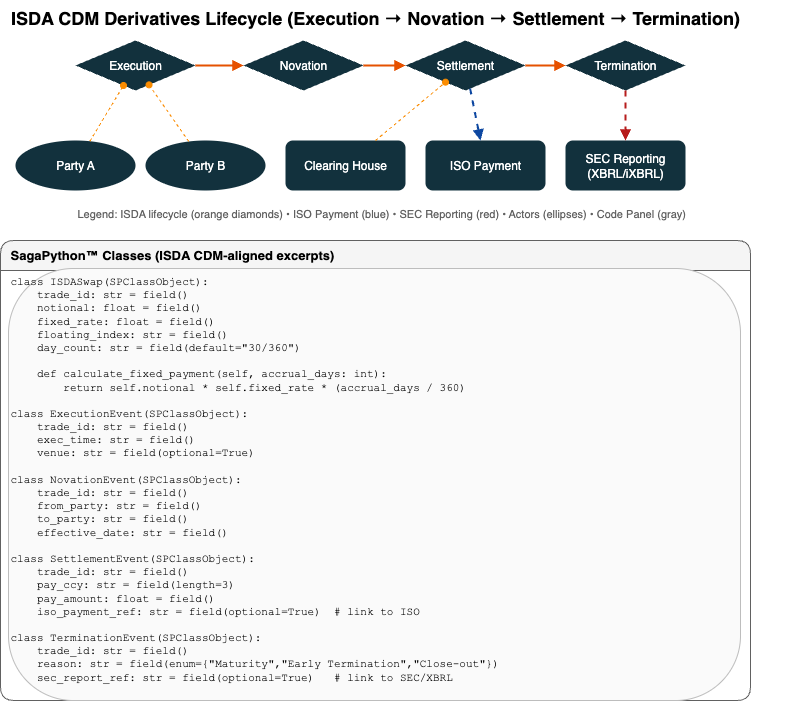
The ISDA Common Domain Model (CDM) seeks to standardize the derivatives lifecycle. In practice, its adoption is limited by tooling and integration costs.
SagaChain™ Encoding
ISDA lifecycle events are native SagaPython™ methods:
@sagaclass()
class ISDASwap(SPClassObject):
 swap_id: str = sagafield()
 notional: float = sagafield()
 ccy: str = sagafield(length=3)
 counterparty_a: str = sagafield()
 counterparty_b: str = sagafield()

 @sagamethod()
 def terminate(self):
 self.status = "Terminated"
Code language: 1C:Enterprise (v7, v8) (1c)- SagaScale™: Supports high-frequency derivatives activity.
- SagaInterop™: Netting and margining can interoperate with external blockchains.
- SagaFeeds™: Public indices enable transparency in aggregated derivatives exposure.
- Private Enclaves: Proprietary models for valuation and risk can execute confidentially.
Implications
- Industry: Seamless derivatives lifecycle management.
- Regulators: Real-time systemic derivatives risk monitoring.
- SDOs: CDM operationalized as persistent, interoperable code.
3. Conclusion
These six standards represent the foundation of the global financial system. By encoding them as SagaPython™ classes on SagaChain™, the Financial Class Tree eliminates fragmentation, embeds compliance at the protocol level, and ensures interoperability across domains. Together, they form the base layer of the Unified Global Financial Class Tree, which integrates with regulatory class trees in Section 4.
4. Regulatory Class Trees
Overview
The global financial ecosystem is shaped not only by technical standards such as ISO 20022 or FIX, but also by regulatory reporting frameworks and supervisory datasets. These frameworks define eligibility, prudential requirements, disclosures, and systemic oversight. Traditionally, they exist in silos: EDGAR for SEC, call report systems for FDIC and OCC, NIC datasets for the Federal Reserve, and so forth.
SagaChain™ enables these regulatory datasets to live as persistent, multi-inheritable classes alongside standards. Each regulator’s mandates become first-class citizens in the global class tree, creating a compliance-by-design infrastructure where supervision, reporting, and market activity converge.
4.1 U.S. Securities and Exchange Commission (SEC)
Context and Limitations
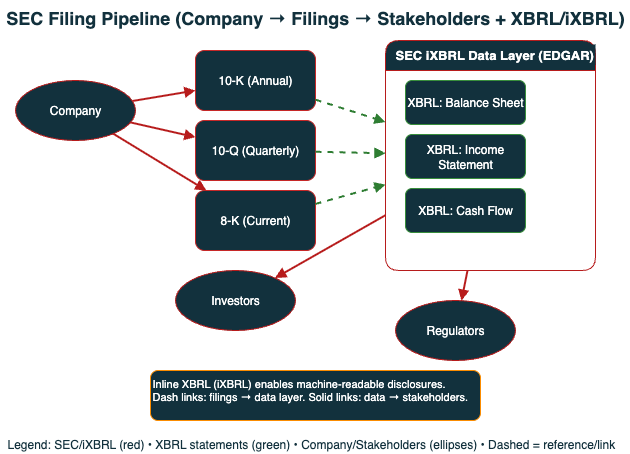
The SEC mandates disclosures such as 10-K, 10-Q, and 8-K through the EDGAR system. While XBRL integration has improved machine readability, filings remain static documents disconnected from the actual transactions and instruments they describe. Latency, reconciliation costs, and selective disclosure remain challenges.
SagaChain™ Encoding
On SagaChain™, SEC filings are persistent composite objects linking directly to the trades, payments, and identifiers in Section 3.
@sagaclass()
class SEC10K(SPClassObject):
 cik: str = sagafield()
 filing_date: str = sagafield(pattern=r"\d{4}-\d{2}-\d{2}")
 risk_factors: str = sagafield()
 mdna: str = sagafield()
 auditor_report: str = sagafield()

 @sagamethod()
 def attest(self, auditor_oid: str):

 # Link to auditor account, enforce attestation
 pass
Code language: 1C:Enterprise (v7, v8) (1c)
Integration
- SagaScale™: Billions of filings persist while linked objects (XBRL, ISO, FIX) are co-located.
- SagaInterop™: Disclosures can be referenced externally by investors or auditors on other chains.
- SagaFeeds™: Public indices allow a multitude of queries (e.g., “all 10-Ks in banking sector this quarter”).
- Private Enclaves: Draft filings can be prepared confidentially, with only proofs made public until disclosure deadlines.
4.2 Federal Reserve System (FRB + Board of Governors)
Context and Limitations
The Federal Reserve publishes key datasets (H.15 rates, H.4.1 balance sheet, Z.1 Financial Accounts, SLOOS surveys) and collects FR Y-9 data for bank holding companies. These datasets are essential for policy, supervision, and market benchmarks. Currently, they are distributed through static files and APIs, disconnected from transactional provenance.
SagaChain™ Encoding
On SagaChain™, these references are persistent classes:
@sagaclass()
class FRB_H15Rate(SPClassObject):
 date: str = sagafield(pattern=r"\d{4}-\d{2}-\d{2}")
 maturity: str = sagafield(enum={"1M","3M","2Y","10Y","30Y"})
 rate: float = sagafield()

@sagaclass()
class FRB_BalanceSheetItem(SPClassObject):
 as_of_date: str = sagafield()
 category: str = sagafield()
 amount: float = sagafield()
Code language: 1C:Enterprise (v7, v8) (1c)
Integration
- SagaScale™: Rates and balance sheet items scale with historical depth and global access.
- SagaInterop™: These classes serve as reference rates in cross-chain settlement or DeFi-like systems, with proofs back to SagaChain™.
- SagaFeeds™: Regulators and industry can query yield curves or systemic liquidity snapshots.
- Private Enclaves: Sensitive supervisory data (FR Y-9 filings) may remain confidential, publishing only aggregates.

4.3 Office of the Comptroller of the Currency (OCC)
Context and Limitations
The OCC charters national banks and issues supervisory assessments such as CRA evaluations. Much of its data is siloed in call reports (via FFIEC CDR) or static PDFs.
SagaChain™ Encoding
@sagaclass()
class OCC_NationalBankCharter(SPClassAccount):
 charter_id: str = sagafield()
 bank_name: str = sagafield()
 date_granted: str = sagafield()
 status: str = sagafield(enum={"Active","Revoked","Pending"})

@sagaclass()
class OCC_CRAEvaluation(SPClassObject):
 bank_oid: str = sagafield()
 eval_date: str = sagafield()
 rating: str = sagafield(enum={"Outstanding","Satisfactory","NeedsImprovement","SubstantialNoncompliance"})
Code language: 1C:Enterprise (v7, v8) (1c)
Integration
- SagaScale™: OCC evaluations scale across thousands of banks.
- SagaInterop™: OCC charters link with FDIC insurance objects, ensuring regulatory consistency.
- SagaFeeds™: CRA performance ratings are queryable by bank, region, or date.
- Private Enclaves: Confidential examination data can remain private, publishing only the public CRA ratings.
4.4 Federal Deposit Insurance Corporation (FDIC)
Context and Limitations
The FDIC maintains call reports, institution directories, and records of bank failures. This data is essential for deposit insurance, counterparty risk, and systemic analysis.
SagaChain™ Encoding
@sagaclass()
class FDIC_InsuredInstitution(SPClassAccount):
 cert_number: str = sagafield()
 name: str = sagafield()
 city: str = sagafield()
 state: str = sagafield()

@sagaclass()
class FDIC_BankFailureEvent(SPClassObject):
 institution_oid: str = sagafield()
 failure_date: str = sagafield()
 receiver: str = sagafield()
Code language: 1C:Enterprise (v7, v8) (1c)
Integration
- SagaScale™: Thousands of institutions and historical failures are indexed and scalable.
- SagaInterop™: FDIC data integrates with OCC and NCUA classes for cross-regulator oversight.
- SagaFeeds™: Access to indices to allow queries of active vs. failed banks.
- Private Enclaves: Confidential resolution strategies remain private, proofs made public post-event.

4.5 National Credit Union Administration (NCUA)
Context and Limitations
The NCUA supervises credit unions and publishes call report data, often lagging and siloed.
SagaChain™ Encoding
@sagaclass()
class NCUA_CreditUnion(SPClassAccount):
 charter_number: str = sagafield()
 name: str = sagafield()
 assets: float = sagafield()

@sagaclass()
class NCUA_CallReportEntry(SPClassObject):
 credit_union_oid: str = sagafield()
 period: str = sagafield()
 metric: str = sagafield()
 value: float = sagafield()
Code language: 1C:Enterprise (v7, v8) (1c)
Integration
- SagaScale™: Millions of call report entries scale without reconciliation.
- SagaInterop™: Integrates with FFIEC and FDIC data for unified supervision.
- SagaFeeds™: Public indices allow consumers to verify credit union health.
- Private Enclaves: Examination details can remain private while compliance proofs are anchored.

4.6 Federal Financial Institutions Examination Council (FFIEC)
Context and Limitations
The FFIEC standardizes reporting across agencies (FDIC, OCC, FRB, NCUA). Its datasets include call reports and HMDA mortgage disclosure data. Today, access is fragmented across portals.
SagaChain™ Encoding
@sagaclass()
class FFIEC_CallReport(SPClassObject):
 report_id: str = sagafield()
 bank_oid: str = sagafield()
 quarter: str = sagafield()
 metric: str = sagafield()
 value: float = sagafield()

@sagaclass()
class FFIEC_HMDARecord(SPClassObject):
 loan_id: str = sagafield()
 applicant_income: float = sagafield()
 property_location: str = sagafield()
 loan_outcome: str = sagafield(enum={"Approved","Denied"})
Code language: CSS (css)
Integration
- SagaScale™: Billions of HMDA records scale globally.
- SagaInterop™: Mortgage data links to HUD housing and CFPB complaints.
- SagaFeeds™: Regulators and researchers query mortgage trends without intermediaries.
- Private Enclaves: Sensitive applicant data remains private, proofs public.

Encoding regulatory frameworks as persistent SagaPython™ classes transforms compliance into a real-time, interoperable system. From SEC disclosures to FRB rates, OCC charters, FDIC failures, NCUA call reports, and FFIEC HMDA datasets, these classes integrate seamlessly into the global tree alongside standards.
This architecture delivers:
- Industry: reduced compliance costs, real-time counterparty risk insights.
- Government/Regulators: direct, zero-lag oversight.
- Standards bodies (SDOs): integration of their taxonomies with supervisory realities.
4.7 Commodity Futures Trading Commission (CFTC)
Context and Limitations
The CFTC oversees derivatives markets, publishing data such as the Commitments of Traders (COT) reports, swap transaction data from Swap Data Repositories (SDRs), and clearing statistics. Today, this data is fragmented across static reports and proprietary feeds.
SagaChain™ Encoding
@sagaclass()
class CFTC_FuturesPosition(SPClassObject):
 report_date: str = sagafield()
 commodity: str = sagafield()
 long_positions: int = sagafield()
 short_positions: int = sagafield()

@sagaclass()
class CFTC_SwapTransaction(SPClassObject):
 swap_id: str = sagafield()
 counterparty_a: str = sagafield()
 counterparty_b: str = sagafield()
 notional: float = sagafield()
 ccy: str = sagafield(length=3)
Code language: 1C:Enterprise (v7, v8) (1c)
Integration
- SagaScale™: Futures and swaps scale to millions of positions with historical depth.
- SagaInterop™: Cross-chain margining with external ledgers.
- SagaFeeds™: Aggregates for systemic monitoring.
- Private Enclaves: Sensitive counterparty details remain private while exposures are provable.

4.8 Consumer Financial Protection Bureau (CFPB)
Context and Limitations
The CFPB publishes consumer complaint data and supervises consumer products. Complaint datasets are valuable early-warning signals but are lagged and inconsistent.
SagaChain™ Encoding
@sagaclass()
class CFPB_ConsumerComplaint(SPClassObject):
 complaint_id: str = sagafield()
 product: str = sagafield()
 issue: str = sagafield()
 company: str = sagafield()
 date_received: str = sagafield()
 status: str = sagafield(enum={"Open","Closed"})
Code language: 1C:Enterprise (v7, v8) (1c)
Integration
- SagaScale™: Millions of complaints scale across shards.
- SagaInterop™: Links to OCC/FDIC charters, creating lineage from complaint → institution.
- SagaFeeds™: Public indices expose complaint heatmaps.
- Private Enclaves: Personally identifiable information (PII) remains confidential.

4.9 Office of Financial Research (OFR, Treasury)
Context and Limitations
OFR develops systemic risk datasets and maintains links to the Legal Entity Identifier (LEI) system. Current datasets are siloed, often delayed, and lack binding to live transactions.
SagaChain™ Encoding
@sagaclass()
class OFR_FinancialStabilityIndicator(SPClassObject):
 indicator_id: str = sagafield()
 description: str = sagafield()
 value: float = sagafield()
 as_of: str = sagafield()

@sagaclass()
class OFR_LEILinkage(SPClassObject):
 parent_lei: str = sagafield()
 child_lei: str = sagafield()
 relationship: str = sagafield()
Code language: CSS (css)
Integration
- SagaScale™: Systemic indicators scale across real-time feeds.
- SagaInterop™: Global LEI integration links directly to FIGI and FIBO classes.
- SagaFeeds™: Risk dashboards built from available indices.
- Private Enclaves: Restricted supervisory data remains private, proofs public.

4.10 Financial Crimes Enforcement Network (FinCEN)
Context and Limitations
FinCEN supervises anti-money laundering (AML) and Bank Secrecy Act (BSA) compliance. While Suspicious Activity Reports (SARs) are not public, advisories and rule lists are.
SagaChain™ Encoding
@sagaclass()
class FinCEN_Advisory(SPClassObject):
 advisory_id: str = sagafield()
 date_issued: str = sagafield()
 topic: str = sagafield()
 content_hash: str = sagafield()

@sagaclass()
class FinCEN_AMLRule(SPClassObject):
 rule_id: str = sagafield()
 description: str = sagafield()
 effective_date: str = sagafield()
Code language: 1C:Enterprise (v7, v8) (1c)
Integration
- SagaScale™: Advisories and rulesets scale without reconciliation.
- SagaInterop™: AML rules reference OFAC sanctions lists.
- SagaFeeds™: Public indices anchor compliance rules globally.
- Private Enclaves: SARs/CTR reports can be logged privately with proofs.

4.11 Office of Foreign Assets Control (OFAC, Treasury)
Context and Limitations
OFAC sanctions lists are distributed in machine-readable form but are updated frequently and inconsistently integrated into financial systems.
SagaChain™ Encoding
@sagaclass()
class OFAC_SanctionedParty(SPClassObject):
 party_id: str = sagafield()
 name: str = sagafield()
 program: str = sagafield()
 list_type: str = sagafield(enum={"SDN","SSI","CAPTA"})
 effective_date: str = sagafield()
Integration
- SagaScale™: List updates propagate to all shards.
- SagaInterop™: Sanction checks integrated with cross-chain payment flows.
- SagaFeeds™: Access to screening queries.
- Private Enclaves: Client-screening runs privately, proofs anchored publicly.

4.12 Federal Housing Finance Agency (FHFA)
Context and Limitations
FHFA supervises Fannie Mae, Freddie Mac, and the Federal Home Loan Banks. It publishes house price indices (HPI) and credit risk transfer data.
SagaChain™ Encoding
@sagaclass()
class FHFA_HPI(SPClassObject):
 region: str = sagafield()
 date: str = sagafield()
 hpi_value: float = sagafield()

@sagaclass()
class FHFA_CreditRiskTransfer(SPClassObject):
 pool_id: str = sagafield()
 tranche: str = sagafield()
 loss_share: float = sagafield()
Code language: 1C:Enterprise (v7, v8) (1c)
Integration
- SagaScale™: Nationwide mortgage data scales globally.
- SagaInterop™: Links to HUD and FFIEC mortgage data.
- SagaFeeds™: Access to housing affordability metrics.
- Private Enclaves: Proprietary mortgage models remain confidential.

4.13 Department of Housing and Urban Development (HUD)
Context and Limitations
HUD manages FHA loans, grants, and neighborhood programs. Data is fragmented and difficult to integrate.
SagaChain™ Encoding
@sagaclass()
class HUD_FHAEndorsement(SPClassObject):
 loan_id: str = sagafield()
 endorsement_date: str = sagafield()
 amount: float = sagafield()

@sagaclass()
class HUD_NeighborhoodGrant(SPClassObject):
 grant_id: str = sagafield()
 location: str = sagafield()
 value: float = sagafield()
Code language: CSS (css)
Integration
- SagaScale™: Millions of FHA records scale without reconciliation.
- SagaInterop™: Links to FFIEC HMDA and CFPB complaints.
- SagaFeeds™: Queryable neighborhood-level housing data.
- Private Enclaves: Borrower-level data remains private.

4.14 Pension Benefit Guaranty Corporation (PBGC)
Context and Limitations
PBGC guarantees private pension plans and tracks plan terminations. Data is public but often aggregated.
SagaChain™ Encoding
@sagaclass()
class PBGC_DefinedBenefitPlan(SPClassObject):
 plan_id: str = sagafield()
 sponsor: str = sagafield()
 participants: int = sagafield()

@sagaclass()
class PBGC_TerminationEvent(SPClassObject):
 plan_id: str = sagafield()
 date: str = sagafield()
 reason: str = sagafield()
Code language: 1C:Enterprise (v7, v8) (1c)
Integration
- SagaScale™: Nationwide pension data scales.
- SagaInterop™: Links to SEC 10-K disclosures of pension obligations.
- SagaFeeds™: Access to indices allow systemic pension risk monitoring.
- Private Enclaves: Proprietary sponsor data remains private.

4.15 Small Business Administration (SBA)
Context and Limitations
SBA administers 7(a) and 504 loans and historically managed PPP loans. Loan-level data is published but disconnected from counterparties.
SagaChain™ Encoding
@sagaclass()
class SBA_Loan(SPClassObject):
loan_id: str = sagafield()
program: str = sagafield(enum={"7a","504","PPP"})
amount: float = sagafield()
status: str = sagafield()
Code language: 1C:Enterprise (v7, v8) (1c)
Integration
- SagaScale™: Millions of SME loans scale.
- SagaInterop™: Links to Treasury and FDIC small bank data.
- SagaFeeds™: Access to indices allow SME ecosystem monitoring.
- Private Enclaves: Borrower-level details remain private.

4.16 Macro & Treasury References (BEA, BLS, Treasury)
Bureau of Economic Analysis (BEA)
Encodes GDP, PCE, and NIPA series as ClassMacroSeries objects, allowing on-chain macro normalization.
Bureau of Labor Statistics (BLS)
Encodes CPI, PPI, and unemployment series as ClassPriceIndex and ClassLaborMetric objects.
U.S. Treasury Fiscal Service
Encodes Treasury auctions, securities, and Daily Statements:
@sagaclass()
class UST_Auction(SPClassObject):
 cusip: str = sagafield()
 auction_date: str = sagafield()
 amount: float = sagafield()
 yield_pct: float = sagafield()
Code language: 1C:Enterprise (v7, v8) (1c)
4.17 FINRA (SRO)
Data scope: TRACE corporate/agency bond trade reports (licensing), OTC transparency datasets, and CAT references (restricted).
Role: Market surveillance, transparency, broker-dealer oversight.
4.17.1 Context & Constraints
FINRA’s transparency programs (e.g., TRACE) are the de facto source for U.S. fixed-income trade prints; CAT aggregates O/T trade lifecycle events. However, most raw feeds are licensed/restricted. On SagaChain™, we model:
- Open/public facets as fully persisted objects.
- Licensed payloads as schema references + provenance (hashes, timestamps, license URI), with optional ingestion to Private Enclaves for confidential analytics and publication of verifiable proofs (e.g., aggregate liquidity stats, outlier flags).
4.17.2 SagaPython™ Classes (FINRA)
@sagaclass()
class FINRA_BrokerDealer(SPClassAccount):
 crd_number: str = sagafield()
 legal_name: str = sagafield()
 status: str = sagafield(enum={"Active","Terminated","Suspended"})

@sagaclass()
class FINRA_TRACERef(SPClassObject):

 """

 Reference wrapper for licensed TRACE trade data.

 Stores schema hash, license terms, and optional enclave payload handle.

 """

 trace_schema_hash: str = sagafield()
 license_uri: str = sagafield()
 provenance_txn: str = sagafield()
 enclave_handle: str = sagafield(optional=True) # pointer if analyzed privately

 @sagamethod()
 def attest_schema(self) -> str:
 return f"attest:{self.trace_schema_hash}"

@sagaclass()
class FINRA_BondTradeRef(SPClassObject):

 """

 Public summary compatible with licensing: minimal fields + FIGI link.

 """

 trade_dt: str = sagafield(pattern=r"\d{4}-\d{2}-\d{2}")
 price: float = sagafield()
 qty: float = sagafield()
 figi: str = sagafield(length=12) # FIGI anchor
 broker_dealer_crd: str = sagafield()
 trace_ref_oid: str = sagafield(optional=True) # link to FINRA_TRACERef

 @sagamethod()
 def anonymized_view(self):
 return {"trade_dt": self.trade_dt, "price": self.price, "qty": self.qty, "figi": self.figi}
Code language: 1C:Enterprise (v7, v8) (1c)
4.17.3 CAT (Restricted) via Private Enclaves
CAT lifecycle analytics (route/modify/cancel/execute) run in Private Enclaves; only aggregates and proofs are published:
@sagaclass()
class FINRA_CAT_AggregateProof(SPClassObject):
 as_of: str = sagafield()
 metric: str = sagafield(enum={"FillRatio","CancelRate","OrderAging"})
 value: float = sagafield()
 proof_ref: str = sagafield() # e.g., zk-proof digest
Code language: 1C:Enterprise (v7, v8) (1c)
4.17.4 Interoperability
- FIGI: FINRA_BondTradeRef.figi = canonical instrument identity.
- FIX: execution lineage can link to FINRA summaries (post-trade validation).
- SEC/XBRL: issuer disclosures reconcile with secondary-market prints.
- SagaFeeds: publish public summaries and proofs; guard licensed payloads.

4.18 MSRB (SRO) / EMMA
Data scope: Municipal disclosures (OS, continuing disclosures) and muni trade data (terms vary by element).
Role: Transparency and disclosure for municipal securities via EMMA.
4.18.1 Context & Constraints
EMMA hosts official statements (OS), event notices, and trade data. Portions are public; some redistribution terms apply. On SagaChain™, we store:
- Disclosure metadata + cryptographic hashes as persistent objects.
- Trade summaries with FIGI / muni identifiers.
- Document content by URL/provenance; full text may be referenced, not replicated, respecting terms.
4.18.2 SagaPython™ Classes (MSRB/EMMA)
@sagaclass()

class MSRB_MuniSecurity(SPClassObject):
 figi: str = sagafield(length=12) # where available
 cusip9: str = sagafield(length=9)
 issuer_name: str = sagafield()
 state: str = sagafield(length=2)

@sagaclass()
class EMMA_DisclosureRef(SPClassObject):

 """

 Metadata + hashes for OS/continuing disclosures.

 """

 security_ref: str = sagafield() # OID -> MSRB_MuniSecurity
 filing_type: str = sagafield(enum={"OfficialStatement","ContinuingDisclosure","EventNotice"})
 filing_date: str = sagafield(pattern=r"\d{4}-\d{2}-\d{2}")
 doc_hash: str = sagafield()
 emma_uri: str = sagafield()

 @sagamethod()
 def verify(self, hash_check: str) -> bool:
 return hash_check == self.doc_hash

@sagaclass()
class MSRB_MuniTradeRef(SPClassObject):
 trade_dt: str = sagafield(pattern=r"\d{4}-\d{2}-\d{2}")
 price: float = sagafield()
 qty: float = sagafield()
 trade_type: str = sagafield(enum={"CustomerBuy","CustomerSell","Interdealer"})
 security_ref: str = sagafield() # OID -> MSRB_MuniSecurity

 @sagamethod()
 def public_view(self):
 return {"dt": self.trade_dt, "px": self.price, "qty": self.qty}
Code language: 1C:Enterprise (v7, v8) (1c)
4.18.3 Interoperability
- FIGI/CUSIP: identity anchoring for muni instruments.
- SEC/XBRL: issuer financials linked to muni disclosures for credit analysis.
- SagaFeeds: browsing of disclosure metadata and trade summaries (subject to MSRB terms).

4.19 SIPC (Non-Government, Nonprofit)
Data scope: Broker-dealer membership lists, customer protection/liquidation proceedings (public summaries).
Role: Investor protection in broker-dealer liquidations.
4.19.1 Context
SIPC membership status and liquidation case updates matter for counterparty risk and customer asset protection. These are typically public summaries that can be persisted on-chain for real-time verification and linkage to institutions and customer accounts.
4.19.2 SagaPython™ Classes (SIPC)
@sagaclass()
class SIPC_Member(SPClassAccount):
 crd_number: str = sagafield()
 member_name: str = sagafield()
 membership_status: str = sagafield(enum={"Active","Terminated"})
 effective_date: str = sagafield(pattern=r"\d{4}-\d{2}-\d{2}")

@sagaclass()
class SIPC_LiquidationEvent(SPClassObject):
 case_id: str = sagafield()
 member_crd: str = sagafield()
 court: str = sagafield()
 filing_date: str = sagafield(pattern=r"\d{4}-\d{2}-\d{2}")
 summary: str = sagafield()

 @sagamethod()
 def public_notice(self) -> dict:
 return {
 "case_id": self.case_id, "member_crd": self.member_crd,
 "filing_date": self.filing_date, "court": self.court
 }
Code language: 1C:Enterprise (v7, v8) (1c)
4.19.3 Interoperability
- FINRA_BrokerDealer ←→ SIPC_Member via shared CRD.
- SEC/XBRL issuer/broker relationships for risk disclosure.
- SagaFeeds: publish membership status and liquidation notices for public verification.

Licensing, Privacy, and Governance Notes (for all three subsections)
Licensing & Terms
- FINRA TRACE, CAT, and some EMMA datasets have licensing or usage restrictions. On SagaChain™, store schema refs, hashes, timestamps, and license URIs publicly; ingest raw payloads only where legal, ideally within Private Enclaves.
Private Enclaves & Proofs
- Restricted data is analyzed inside TEE-backed enclaves, producing aggregated metrics (e.g., spread distributions, outlier flags) and cryptographic proofs (hash attestations or zk-proof references) to publish on-chain without exposing raw data.
Indices & Access
- SagaFeeds should expose public facets (metadata, proofs, summaries). Index keys: CRD, FIGI/CUSIP, filing/notice dates, instrument sector, etc.
Integration into the Unified Global Class Tree
- FINRA_BondTradeRef and MSRB_MuniTradeRef inherit or link to FIGI/CUSIP and connect to FIX/ISO flows where applicable.
- SIPC_Member joins FINRA_BrokerDealer (CRD) and SEC registrant references, enabling consistent counterparty and customer-asset protection views.
Mini “Unified” Examples (Cross-Wiring)
Unified Broker-Dealer Profile (FINRA + SIPC + SEC)
@sagaclass()
class UnifiedBrokerDealer(FINRA_BrokerDealer, SIPC_Member, SEC10K):
 lei: str = sagafield(length=20)

 @sagamethod()
 def compliance_snapshot(self):
 return {
 "crd": self.crd_number,
 "sipc_status": self.membership_status,
 "sec_filer": getattr(self, "cik", None)
 }
Code language: 1C:Enterprise (v7, v8) (1c)
Unified Muni Instrument (MSRB + FIGI + XBRL Linkage)
@sagaclass()
class UnifiedMuniInstrument(MSRB_MuniSecurity, FIGIIdentifier):

 @sagamethod()
 def disclosure_urls(self) -> list:
 # would query linked EMMA_DisclosureRef via indices
 return []
Code language: 1C:Enterprise (v7, v8) (1c)
4. Conclusion
Regulatory frameworks, once siloed in agency portals and proprietary feeds, are unified on SagaChain™ as persistent, auditable classes. SEC filings, FRB rates, OCC charters, FDIC failures, CFPB complaints, OFAC sanctions, HUD loans, PBGC pensions, SBA lending, and Treasury auctions now live alongside standards like ISO and FIX in a single global class tree.
- For Industry: seamless compliance, reduced costs, systemic transparency.
- For Government: real-time supervisory visibility, consistent lineage, privacy-preserving proofs.
- For SDOs: standards integrated with regulation, closing the loop between specification and enforcement.
Together, Sections 3 and 4 demonstrate that the Unified Global Financial Class Tree is not aspirational it is implementable with SagaChain™, powered by SagaCoin™.
5. Unified Global Class Tree
Overview
The previous sections demonstrated how international standards (ISO, FIX, XBRL, FIGI, FIBO, ISDA) and regulatory frameworks (SEC, FRB, OCC, FDIC, CFPB, OFAC, Treasury, etc.) can be individually encoded as SagaPython™ classes. The transformative innovation of SagaChain™ is not that these classes exist independently, but that they can coexist within one canonical global class tree, inheriting from one another and interoperating seamlessly.
This section illustrates how the Unified Global Class Tree functions as the semantic and operational backbone of global finance eliminating reconciliation, embedding compliance, and ensuring persistent interoperability across all domains.
5.1 Multi-Inheritance as the Core Mechanism
SagaPython™ leverages Python’s C3 linearization algorithm for multiple inheritance. This allows financial objects to inherit from multiple standards and regulatory classes simultaneously, ensuring that a single object can fulfill multiple roles:
- A trade can be at once:
- a FIX order (trading semantics),
- an ISO 20022 payment (settlement semantics),
- a FIGI identifier (instrument identity),
- an SEC disclosure (reporting semantics).
- A bank can be at once:
- an OCC chartered entity,
- an FDIC insured institution,
- an NCUA supervised credit union (if cooperative),
- a CFPB subject of consumer complaints,
- an FRB counterparty in monetary operations.
This model guarantees that no standard or regulator’s requirements are duplicated or “bolted on”. Instead, they become first-class parents in the class hierarchy.
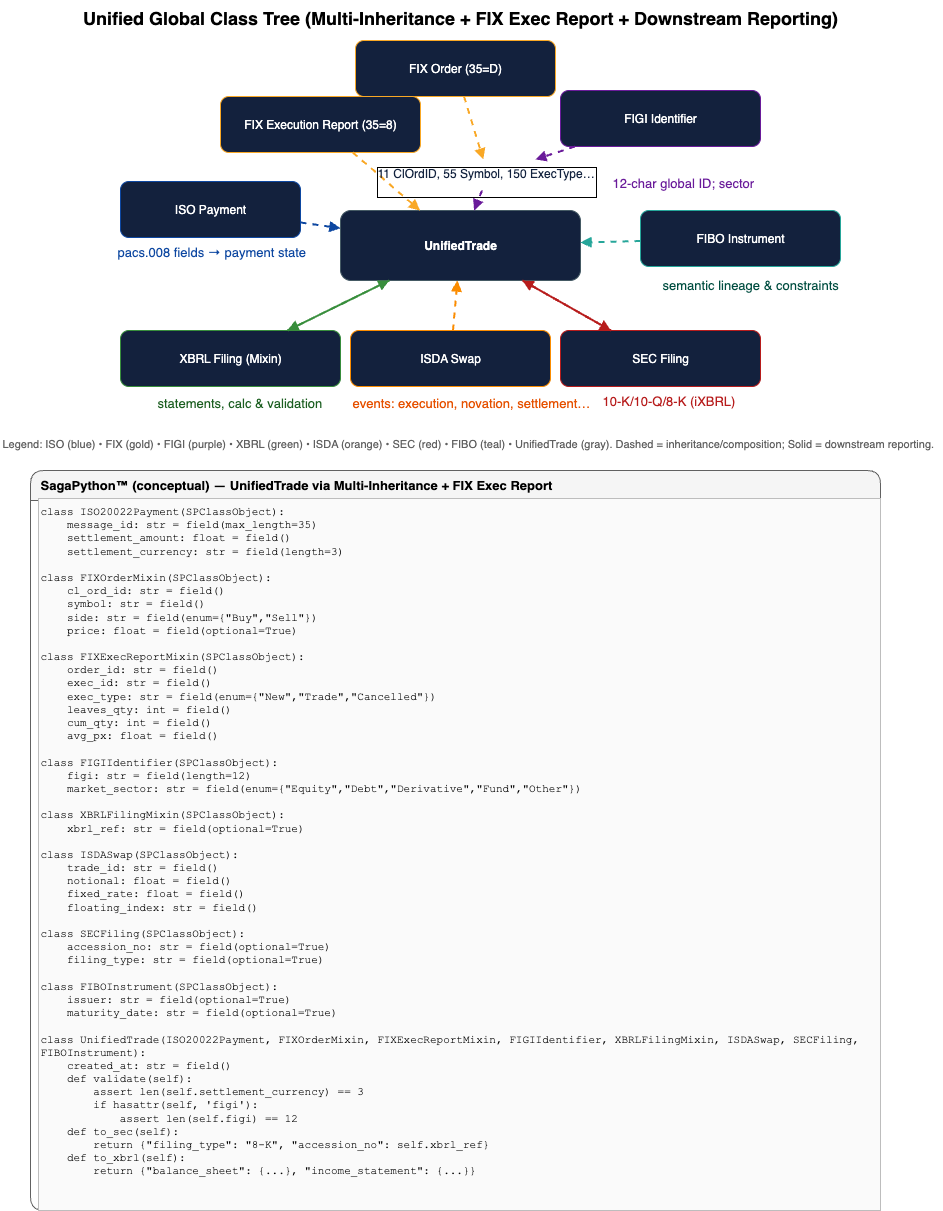
5.2 Example: Unified Trade Object
The simplest but most powerful illustration is the UnifiedTrade class:
@sagaclass()
class UnifiedTrade(FIXOrder, ISO20022_Pacs008, FIGIIdentifier, SEC10K, CFTC_SwapTransaction):
 trade_date: str = sagafield(pattern=r"\d{4}-\d{2}-\d{2}")
 status: str = sagafield(enum={"New","Executed","Settling","Settled","Reported"})

 @sagamethod()
 def settle_and_report(self):

 # Settle through ISO 20022 fields
 assert self.amount > 0 and self.currency
 self.status = "Settled"

 # Automatically generate link to SEC disclosure
 self.reported = True
Code language: 1C:Enterprise (v7, v8) (1c)
Key Features
- FIXOrder: captures trading attributes (symbol, qty, price, side).
- ISO20022_Pacs008: ensures payment and settlement alignment.
- FIGIIdentifier: anchors the instrument identity.
- SEC10K: links to disclosure obligations.
- CFTC_SwapTransaction: ensures derivatives compliance where relevant.
Outcome: A single object, with one Object ID (OID), is legally, operationally, and regulatorily valid across all domains.
5.3 Example: Unified Institution Object
Banks, credit unions, and broker-dealers face overlapping mandates across OCC, FDIC, NCUA, CFPB, FRB, and SEC. SagaChain™ collapses these into a UnifiedInstitution:
@sagaclass()
class UnifiedInstitution(OCC_NationalBankCharter, FDIC_InsuredInstitution, NCUA_CreditUnion, CFPB_ConsumerComplaint, FRB_BalanceSheetItem):
 lei: str = sagafield(length=20)
 legal_name: str = sagafield()
 institution_type: str = sagafield(enum={"Bank","CreditUnion","BrokerDealer"})

 @sagamethod()
 def publish_compliance_snapshot(self):

 # Aggregate regulatory views into one proof
 return {
 "charter": self.charter_id,
 "insurance": self.cert_number,
 "assets": self.amount,
 "complaints": self.status
 }
Code language: 1C:Enterprise (v7, v8) (1c)
Key Features
- OCC: charter identity.
- FDIC: insurance coverage.
- NCUA: credit union chartering.
- CFPB: consumer complaint status.
- FRB: systemic balance sheet integration.
Outcome: Supervisors and counterparties see one integrated object, not fragmented filings.

5.4 Unified Macro-Financial Layer
The Unified Global Class Tree is not only transactional but also macroeconomic. By inheriting from BEA, BLS, and Treasury classes, systemic metrics are baked directly into the financial object layer.
@sagaclass()
class UnifiedMacroReference(UST_Auction, FRB_H15Rate, BEA_MacroSeries, BLS_PriceIndex):
 as_of: str = sagafield()
Code language: 1C:Enterprise (v7, v8) (1c)
Use Case: A swap object can directly reference its yield curve inputs (FRB H.15), inflation indexation (BLS CPI), and benchmark GDP context (BEA NIPA), all as live parents.

5.5 Benefits of the Unified Global Class Tree
For Industry
- Elimination of reconciliation layers: A single object satisfies multiple domains.
- Reduced vendor lock-in: Compliance logic is embedded in chain protocol, not third-party middleware.
- Operational efficiency: Trades, payments, disclosures, and compliance reports are atomic.
For Regulators
- Real-time supervision: Regulators query SagaFeeds™ instead of waiting for filings.
- Systemic aggregation: Risks are visible as they form, not after-the-fact.
- Privacy-preserving proofs: Private Enclaves protect sensitive data while anchoring compliance.
For Standards Bodies (SDOs)
- Executable specifications: Standards become living classes, not static schemas.
- Interoperability assurance: Standards are never implemented in isolation.
- Governance continuity: Versioning and namespaces preserve lineage without fragmentation.
5.6 Diagrammatic Representation

5. Conclusion
The Unified Global Class Tree demonstrates the full vision of SagaChain:
- One object = many obligations = one truth.
- One class tree = global standards + regulatory compliance.
- One token (SagaCoin) = execution, inter-chain exchange, stabilized purchasing power.
This is the first architecture in history capable of providing a single-instance, compliance-grade financial system, extensible across standards, regulators, industries, and nations without relying on fragmented, reconciliatory infrastructure.
6. Benefits Analysis
Overview
The Financial Class Tree Initiative does more than modernize financial infrastructure: it restructures the very way global markets, regulators, and standards interact. By encoding standards and regulatory frameworks into a single-instance global class tree on SagaChain™, the initiative yields systemic benefits across industry, government, standards bodies, and consumers.
6.1 Industry Benefits
6.1.1 Reduction of Technical Reconciliation
Financial institutions today spend billions annually maintaining middleware to reconcile between trading systems (FIX), settlement instructions (ISO 20022), reporting frameworks (XBRL), and compliance databases. SagaChain™ eliminates the technical duplication: a single UnifiedTrade object persists across all of these standards. While downstream business processes will still require migration and oversight, the reconciliation burden at the protocol layer disappears.
6.1.2 Lower Vendor Dependence
Much of today’s compliance, reporting, and data obligations are brokered through proprietary data vendors or middleware providers. By embedding standards directly into SagaPython™ classes, institutions regain control of their compliance logic, executed natively on-chain instead of outsourced through monopolistic intermediaries.
6.1.3 Predictable Economics
SagaScale™ stabilizes transaction fees paid in SagaCoin™, ensuring predictable costs even under stress. This does not promise reduced clearing or settlement costs, but it does give institutions stable infrastructure economics they can rely on for high-volume operations.
6.1.4 Cross-Chain Strategies
SagaInterop™ allows compliance objects to flow across multiple blockchains. For example, a tokenized security issued on Ethereum can settle through SagaChain™ while remaining tied to regulatory objects (FIGI, ISO, SEC). This avoids expensive bespoke integrations and supports multi-chain strategies.
6.2 Regulatory Benefits
6.2.1 Real-Time Supervision
Instead of delayed, batch filings, regulators can query SagaFeeds™ to monitor systemic activity continuously. Whether FRB rates, FDIC failures, OCC charters, or SEC disclosures, these classes are live and persistent.
6.2.2 Holistic Risk Aggregation
Because SagaChain™ enforces inheritance across standards, regulators can see exposures aggregated across an entire lifecycle: an ISDA swap linked to a FIGI identifier, tied to an ISO 20022 payment, disclosed through SEC, and connected to FRB systemic indicators.
6.2.3 Compliance by Design
SagaOS™ executes validations atomically with business logic. That means regulatory checks are built into the system of record itself, not bolted on later. This provides tamper-proof lineage and reduces enforcement lag.
6.2.4 Privacy-Preserving Oversight
SagaChain™ Private Enclaves allow regulators to receive proofs of compliance without exposing sensitive details. For example, AML screenings may reveal only that they passed or failed, never disclosing personal data, thus balancing oversight with privacy mandates.
6.3 Consumer and Investor Benefits
6.3.1 Transparency
Consumers and investors no longer depend on delayed filings or paid vendor feeds. SagaFeeds™ expose persistent disclosures in real time, available equally to global institutions and individual retail users.
6.3.2 Trust
Because filings and disclosures are anchored to the same persistent objects (trades, payments, instruments), the integrity of disclosures is verifiable. Investors no longer face uncertainty about whether public information matches actual transactions.
6.3.3 Protection
By anchoring consumer complaints (CFPB), deposit insurance (FDIC), and institutional charters (OCC/NCUA) in one tree, consumers gain direct verifiability of institutional legitimacy and status, reducing fraud and misrepresentation risk.
6.3.4 Empowerment
A retail investor in Nairobi or a small business in Ohio can query the same indices as a global hedge fund. Equal access to information reduces asymmetry and empowers smaller market participants.
6.4 Standards Development Organization (SDO) Benefits
6.4.1 Living Standards
Today, standards bodies issue schemas and PDFs, leaving implementation inconsistent. On SagaChain™, standards are encoded directly as classes, guaranteeing faithful execution and alignment with original specifications.
6.4.2 Broader Adoption
Because standards on SagaChain™ are universally queryable, adoption barriers fall. No selective or partial implementations — the canonical definition is preserved globally.
6.4.3 Versioning and Governance
As standards evolve, each version is subclassed within the global tree. This preserves lineage, ensures backward compatibility, and gives SDOs continuous governance without breaking history.
6.4.4 Seamless Regulator Integration
By coexisting in the same global class tree as regulatory classes, standards are not just abstract definitions they are operationalized in compliance workflows. This closes the gap between design and enforcement.
6.5 Quantitative Impacts
Rather than promising immediate reductions in entrenched back-office or clearing costs, the Financial Class Tree Initiative highlights the technical foundations that allow industry and regulators to progressively streamline operations:
- Reconciliation Burden: SagaChain™ removes the need for redundant reconciliation at the technical standards layer. FIX, ISO 20022, FIGI, XBRL, and SEC filings reference the same persistent objects, reducing duplicated middleware and setting the stage for gradual operational simplification.
- Regulatory Latency: Where disclosures today lag 30–90 days, SagaChain’s persistent object state and SagaFeeds™ make near real-time regulatory observation possible, subject to adoption by supervisory authorities.
- Data Access Costs: Current reliance on proprietary vendor feeds (e.g., TRACE, EMMA, commercial APIs) adds billions in global expense. By publishing open, persistent indices as part of chain state, SagaChain™ provides a public good reference layer that reduces dependence on monopolistic intermediaries.
- Consumer Protection: Persistent object lineage ensures faster detection and resolution of fraud, misrepresentation, or misfiling. Instead of reconciling disparate databases, supervisors and consumers can query a single authoritative tree.
- Incremental Migration Path: By preserving legacy standards in versioned subclasses, SagaChain™ enables a phased transition. Institutions can adopt without wholesale replacement of clearing or settlement infrastructure, minimizing disruption.
6.6 Strategic Significance
The impact of the Financial Class Tree Initiative is measured not in speculative cost reductions, but in the structural transformation of financial infrastructure:
- For Industry: A standards-anchored, persistent object model reduces reliance on reconciliation middleware, lowers vendor lock-in, and provides predictable transaction fee economics via SagaCoin™. Institutions gain a flexible compliance backbone without mandating disruptive back-office replacement.
- For Regulators: Real-time visibility, privacy-preserving oversight, and tamper-proof auditability enhance systemic stability and improve crisis response. Supervisors retain control over policy while benefiting from a compliance-by-design infrastructure.
- For Consumers: Access to indices democratizes transparency, giving equal access to data whether for global hedge funds or retail investors. Fraud and misrepresentation become harder to perpetrate when institutional identity and disclosures are anchored in persistent code.
- For Standards Development Organizations (SDOs): By embedding schemas directly into a living class tree, their decades of work are preserved, faithfully executed, and continuously versioned. Standards become operationalized infrastructure rather than static PDFs.
- For Global Finance: SagaChain™ provides a neutral, interoperable layer where standards and regulations converge. Rather than replacing existing infrastructures, it complements them enabling incremental adoption, cross-border harmonization, and public-good compliance.
In sum: The strategic significance of the Financial Class Tree Initiative is not about claiming percentage cost cuts, but about providing the enabling infrastructure upon which industry, regulators, governments, and consumers can collaboratively build the next era of financial transparency, efficiency, and stability.
7. Strategic Roadmap
Overview
The Financial Class Tree Initiative (SagaFinance™) is not a static framework but a phased program of development, adoption, and governance. Success depends on a carefully sequenced roadmap that begins with broad-based membership recruitment and continues through pilot implementations, regulatory integration, cross-border expansion, and global governance.
7.1 Membership & Participation (Foundational Phase)
The first and most essential step is the recruitment of members from government, industry, standards development organizations (SDOs), academia, and civil society. Without early engagement, the initiative risks becoming a purely technical project rather than a true standards-based global infrastructure.
- Government & Regulators: Supervisory authorities (e.g., SEC, FRB, OCC, FDIC, CFTC, CFPB, OFAC) are invited to publish canonical regulatory classes that directly anchor their mandates into persistent SagaPython™ objects.
- Industry: Financial institutions, clearinghouses, market infrastructures, and fintechs join as contributors, piloting integrations and testing standards in operational environments.
- SDOs: ISO, FIX, ISDA, XBRL, FIBO, and others are invited to encode their schemas as living SagaPython™ classes, ensuring continuity and version control.
- Academia & Research: Universities and independent labs contribute to testing, governance design, and training the next generation of developers.
- Consumers & NGOs: Advocacy groups ensure fairness, transparency, and accessibility are embedded into governance.
This foundational phase establishes the governance base under SagaStandards™ and provides the human and institutional capital needed to advance subsequent phases.
7.2 Phase I – Standards Pilot (12 – 18 months)
With membership secured, the first operational milestone is the pilot implementation of key financial standards (ISO 20022, FIX, FIGI, XBRL, ISDA).
- Deliverable: Encode pilot classes as SagaPython™ objects and run testnet demonstrations of multi-inheritance (e.g., UnifiedTrade object spanning FIX + ISO + FIGI).
- Participants: SDO members, industry pilot partners, and academic collaborators.
- Objective: Validate the persistent class model, confirm interoperability, and establish proof-of-concept for industry and regulators.
7.3 Phase II – Regulatory Integration (18 – 24 months)
The next step is to bring in regulatory classes to extend the framework beyond standards.
- Deliverable: Publish canonical classes for SEC filings, FRB rates, OCC charters, FDIC failures, CFPB complaints, OFAC sanctions lists, etc.
- Participants: U.S. regulators, supervisory bodies, and their international counterparts.
- Objective: Demonstrate compliance by design, real-time supervisory queries, and privacy-preserving oversight via Private Enclaves.
7.4 Phase III – Cross-Border & Multi-Regulator Expansion (24 – 36 months)
Once standards and initial regulatory classes are proven, expansion moves to cross-border coordination.
- Deliverable: Integrate classes from additional jurisdictions (e.g., ESMA in Europe, MAS in Singapore, JFSA in Japan).
- Participants: International regulators, global SDOs, and cross-border institutions.
- Objective: Build interoperability across borders and regulatory regimes, ensuring the Financial Class Tree is global, not U.S.-centric.
7.5 Phase IV – Global Rollout & Governance (36 – 60 months)
Once standards and initial regulatory classes are proven, expansion moves to cross-border coordination.
- Deliverable: Integrate classes from additional jurisdictions (e.g., ESMA in Europe, MAS in Singapore, JFSA in Japan).
- Participants: International regulators, global SDOs, and cross-border institutions.
- Objective: Build interoperability across borders and regulatory regimes, ensuring the Financial Class Tree is global, not U.S.-centric.
7.6 Roadmap Visualization

7. Conclusion
The Strategic Roadmap demonstrates a pragmatic adoption path: starting with industry standards, expanding to regulators, extending cross-border, and culminating in global governance. Each phase builds confidence and trust while delivering tangible cost savings, compliance improvements, and systemic resilience.
The Financial Class Tree Initiative is not a speculative vision but a structured plan for the next 5 years, with clear milestones for industry, regulators, and standards bodies to achieve together.
8. Conclusion
Overview
The global financial system has evolved through decades of incremental standardization and regulatory development. ISO 20022 unified payment messages; FIX digitized trading communication; XBRL enabled machine-readable reporting; FIGI solved identity fragmentation; FIBO provided ontology; ISDA CDM modeled derivatives lifecycles. Regulators such as the SEC, FRB, OCC, FDIC, CFPB, OFAC, and Treasury each developed frameworks to ensure market integrity, consumer protection, and systemic stability.
Yet the system remains fragmented. Standards live in silos, regulators operate through delayed reporting cycles, and financial institutions spend billions annually reconciling between disconnected systems. The result is inefficiency, opacity, and systemic blind spots.
The Financial Class Tree Initiative proposes a bold but feasible solution: encode all standards and regulatory frameworks as persistent, multi-inheritable SagaPython™ classes on SagaChain, forming a single-instance global class tree of Programmable Smart Assets™ (SagaPSAs™). Unlike first-generation blockchains, SagaChain™ is not a stateless transaction engine but a persistent object system, enabling standards and regulations to coexist as living, executable infrastructure.
Key Contributions
- Technical Foundation: SagaPython™, SagaOS™, SagaPSA™, the Global Single-Instance Class Tree, SagaScale™, SagaInterop™, SagaFeeds™, and Private Enclaves provide the first blockchain architecture capable of compliance-by-design at global scale.
- Standards Integration: ISO, FIX, XBRL, FIGI, FIBO, and ISDA classes demonstrate how market standards can interoperate seamlessly.
- Regulatory Integration: SEC filings, FRB datasets, OCC charters, FDIC institutions, CFPB complaints, OFAC sanctions, and Treasury auctions show regulators’ frameworks can live in the same tree.
- Unified Global Class Tree: Multi-inheritance enables single objects trades, institutions, disclosures to simultaneously fulfill obligations across standards and regulators.
- Strategic Roadmap: A phased plan outlines adoption from industry pilots to global governance under SagaStandards™, with SagaCoin™ as the transaction medium and inter-chain exchange currency.
Transformative Benefits
- For Industry: Massive reductions in reconciliation costs, predictable transaction fees, and seamless interoperability across blockchains and jurisdictions.
- For Regulators: Real-time systemic risk monitoring, compliance by design, and privacy-preserving supervision.
- For Consumers and Investors: Transparent, trustworthy, and universally accessible financial information.
- For Standards Bodies (SDOs): Preservation and amplification of decades of work, transforming static specifications into living, executable code.
Call to Action
The Financial Class Tree Initiative is not speculative it is implementable today. The technology exists; the standards are mature; the regulatory mandates are clear. What is needed now is collaboration:
- Industry participants to pilot ISO and FIX integration.
- Regulators to experiment with live filings and supervisory datasets.
- Standards bodies to steward their taxonomies as persistent SagaPython™ classes.
- Global stakeholders to converge on governance under SagaStandards™.
By acting now, industry, regulators, and SDOs can together build a single-instance global financial infrastructure scalable, interoperable, transparent, and stable.
At the heart of this system lies SagaCoin: not a speculative token, not a state-controlled CBDC, but a public-good currency for transaction fees, inter-chain exchange, and stabilized purchasing power under the SagaCoin™ Management Model.
Closing Vision
For the first time in history, we can envision a world where finance is living code where trades, payments, disclosures, and regulatory obligations are not reconciled across silos but persist in a single global class tree. A world where systemic risks are visible in real time, compliance is automatic, and financial infrastructure serves as a global public good.
The Financial Class Tree Initiative, powered by SagaChain™ and SagaCoin™, offers this future. The choice is not whether this transformation will occur, but whether governments, industry, and standards bodies will lead it together responsibly, inclusively, and for the benefit of all.
Appendices
Appendix A Extended SagaPython™ Code Listings
The following examples illustrate how financial standards and regulatory frameworks are encoded as persistent, inheritable SagaPython™ classes using the Class Manager Infrastructure (CMI). These code samples go beyond earlier sections, providing extended mappings.
A.1 ISO 20022 Payment Instruction
@sagaclass()

class ISO20022_Pacs008(SPClassObject):
 message_id: str = sagafield(max_length=35)
 creation_date_time: str = sagafield(pattern=r"\d{4}-\d{2}-\d{2}T\d{2}:\d{2}:\d{2}")
 settlement_amount: float = sagafield()
 settlement_currency: str = sagafield(length=3)
 instructing_agent: str = sagafield()
 instructed_agent: str = sagafield()

 @sagamethod()

 def validate_payment(self):
 assert self.settlement_amount > 0
 assert len(self.settlement_currency) == 3
Code language: 1C:Enterprise (v7, v8) (1c)
A.2 FIX Protocol Order & Execution Report
@sagaclass()

class FIXOrder(SPClassObject):
 cl_ord_id: str = sagafield()
 symbol: str = sagafield()
 side: str = sagafield(enum={"Buy","Sell"})
 order_qty: int = sagafield()
 price: float = sagafield()

@sagaclass()

class FIXExecutionReport(SPClassObject):
 order_id: str = sagafield()
 exec_id: str = sagafield()
 exec_type: str = sagafield(enum={"New","Trade","Cancelled"})
 leaves_qty: int = sagafield()
 cum_qty: int = sagafield()
 avg_px: float = sagafield()
Code language: 1C:Enterprise (v7, v8) (1c)
A.3 SEC Filing 10-K
@sagaclass()

class SEC10K(SPClassObject):
 cik: str = sagafield()
 company_name: str = sagafield()
 fiscal_year: str = sagafield(pattern=r"\d{4}")
 risk_factors: str = sagafield()
 mdna: str = sagafield()
 auditor_report: str = sagafield()

 @sagamethod()

 def file(self):
 return {"cik": self.cik, "year": self.fiscal_year}
Code language: 1C:Enterprise (v7, v8) (1c)
A.4 Unified Trade Object Multi-Inheritance
@sagaclass()

class UnifiedTrade(FIXOrder, ISO20022_Pacs008, FIGIIdentifier, SEC10K):
 trade_date: str = sagafield(pattern=r"\d{4}-\d{2}-\d{2}")
 status: str = sagafield(enum={"New","Executed","Settled","Reported"})

 @sagamethod()

 def execute_and_report(self):
 self.status = "Settled"
 self.reported = True
Code language: 1C:Enterprise (v7, v8) (1c)
This UnifiedTrade object demonstrates how multi-inheritance collapses fragmentation: a single object functions simultaneously as an order, a settlement instruction, an instrument reference, and a disclosure.
Appendix B Glossary of Terms
SagaChain™: A Layer-1 blockchain designed as a persistent object system, not a stateless transaction log.
SagaPython™: A dialect of Python for SagaChain™, supporting blockchain-native decorators (@sagaclass, @sagamethod, sagafield).
SagaPSA™: (Programmable Smart Assets) Persistent, multi-inheritable SagaPython™ objects representing financial standards and regulatory frameworks.
SagaOS™: The operating layer of SagaChain™ managing persistence, sharding, and namespaces.
Global Class Tree: A single-instance, canonical hierarchy of all classes and objects on SagaChain™, enabling interoperability.
SagaScale™: Dynamic sharding model providing parallel execution, elastic capacity, and predictable fees.
SagaInterop™: Protocol framework for cross-chain interoperability with external blockchains (Ethereum, Solana, Hyperledger, etc.).
SagaFeeds™: Public and permanent indices referencing all class metadata and object instances.
Private Enclaves: Confidential execution environments within SagaChain™, an organization can leverage TEE to allow private computation with public proofs.
SagaCoin™: The native medium of exchange on SagaChain™. Functions as:
- Payment for transaction fees,
- Universal inter-chain settlement currency,
- Stabilized purchasing-power medium under the SagaCoin™ Management Model.
Appendix C: Diagram List
Section 2: SagaChain™ Technology Foundation
- Diagram 2-A: SagaOS™ subsystems: Global Class Registry, Persistent Object Store, Deterministic Message Bus, Sharded Scheduler, Version & Policy Manager.
- Diagram 2-B: A single PSA flows across FIX, ISO 20022, FIGI, and (later) XBRL/SEC without duplication.
- Diagram 2-C: Single global class tree, with versioned branches for standards and regulatory classes.
- Diagram 2-D: SagaScale™ sharding model with account co-location and elastic shard scaling.
- Diagram 2-E: SagaInterop™: outbound commitments, relay verification, and inbound mirrors tied by OIDs.
- Diagram 2-F: Index tiers: ByLEI, ByFIGI, ByStandard, ByRegulator; to read, persistent, and composable.
- Diagram 2-G: Enclave pipeline: encrypted inputs → secure compute → public proof/attestation → index reference.
Section 4: Regulatory Class Trees
- Diagram 4-A: SEC XBRL Filings cross-linked with FIGI identifiers and ISO 20022 payments.
- Diagram 4-B: FRB Data Objects anchoring rates, balance sheets, and systemic indicators.
- Diagram 4-C: OCC Charters and CRA Evaluations linked to institutional accounts.
- Diagram 4-D: FDIC Insured Institution Class linked to OCC Charters and failure events.
- Diagram 4-E: NCUA Credit Union Classes cross-referenced with FDIC and FFIEC reports.
- Diagram 4-F: FFIEC HMDA and Call Reports anchored into the unified class tree.
- Diagram 4-G: CFTC Futures and Swaps Classes linked to ISDA CDM lifecycle objects.
- Diagram 4-H: CFPB Complaints linked to OCC and FDIC institution classes.
- Diagram 4-I: OFR Systemic Indicators linked to FIGI and FIBO instruments.
- Diagram 4-J: FinCEN Advisories and AML Rules integrated with OFAC lists.
- Diagram 4-K: OFAC Lists as persistent, queryable sanction objects.
- Diagram 4-L: FHFA HPI Classes linked with HUD and FFIEC mortgage records.
- Diagram 4-M: HUD FHA Loans linked with CFPB and FFIEC data.
- Diagram 4-N: PBGC Plan Terminations integrated with SEC filings.
- Diagram 4-O: SBA Loans linked with Treasury and FDIC data.
- Diagram 4-FINRA: FINRA TRACE/CAT → (Private Enclave) → public metrics & proofs → SagaFeeds; links to FIGI / FIX / SEC.
- Diagram 4-MSRB: EMMA documents (hash + URI) and trades link to MSRB_MuniSecurity; indices provide public discovery.
- Diagram 4-SIPC: SIPC membership/liquidation linked to FINRA broker-dealers; public indices surface status and proceedings.
Section 5: Unified Global Class Tree
- Diagram 5-A: UnifiedTrade object inheriting from FIX, ISO 20022, FIGI, and SEC classes.
- Diagram 5-B: UnifiedInstitution class diagram showing inheritance from OCC, FDIC, NCUA, CFPB, and FRB.
- Diagram 5-C: UnifiedMacroReference object linking Treasury auctions, Fed rates, GDP, and CPI as persistent classes.
- Diagram 5-D: Conceptual overview: Standards Tree (ISO, FIX, XBRL, FIGI, FIBO, ISDA) on the left, Regulatory Tree (SEC, FRB, OCC, FDIC, CFPB, OFAC, Treasury, etc.) on the right, converging in the Unified Global Class Tree.
Section 7: Strategic Roadmap
- Diagram 7-A: Strategic Roadmap: demonstrates a pragmatic adoption path: starting with industry standards, expanding to regulators, extending cross-border, and culminating in global governance
Appendix D Future Work
- Expansion of Regulatory Class Trees:
Additional agencies such as CFTC, OFAC, HUD, SBA, and international supervisors (ESMA, MAS, JFSA) should be encoded. - Industry-Specific Extensions:
Beyond finance, apply the same methodology to pharmaceuticals, supply chain, and energy markets. - Integration with AI Systems:
SagaChain’s persistent object state offers a foundation for Persistent State-Augmented Generation (PSAG), enabling AI models to reason over live, auditable data rather than ephemeral inputs. - Governance Under SagaStandards™:
Formalize governance processes for standards updates, regulatory mappings, and version lineage.
Conclusion of Appendices
The Appendices provide the technical backbone to the white paper: showing how SagaPython™ is concretely applied, defining key terminology, anchoring visual models, and charting future expansion. They demonstrate that the Financial Class Tree Initiative is not abstract speculation but a practical, implementable, and extensible framework ready for immediate piloting and long-term global adoption.