



Industries ▸ Pharma
Class Tree
Pharma Global Class Tree
An Initiative to Unify Global Pharmaceutical Standards and Regulatory Frameworks on SagaChain™
Research/Draft Prepared By: ChatGPT 5.0, Grok 4.0
Reviewed By: Michael Holdmann, David Beberman, Rich Phillips
Abstract
The SagaPharma™ under the umbrella of SagaStandardsTM, is an effort to unify pharmaceutical standards and regulatory frameworks into a single-instance, multi-inheritable class tree on SagaChain™. Building on decades of work by standards bodies (GS1, CDISC, HL7, IDMP, SPL, FAERS, MedDRA, USP) and regulators (FDA, EMA, WHO, and others), SagaPharma encodes these frameworks as persistent SagaPython™ classes. This transforms them from static specifications into living, interoperable code that operates on a decentralized, permissionless Layer 1 blockchain.
“The initial seeding of the SagaPharma™ Tree and all implemented ALPHA code was completed solely by PraSaga Foundation as a gift to the stakeholders and customers of the real estate industry. This effort is not affiliated with any other Standards Development Organization, Government or Regulatory Agency.
All code was generated from Open Public Machine-Readable sources using both ChatGPT 5.0 and Grok AI platforms to retrieve and convert XML, OWL, JSON, PDF, RDF, CSV, and similar documents into SagaPython™ Classes.
This document research and draft was prepared by the AI platform that generated the respective code and mapped the ontologies, it was reviewed by the PraSaga Foundation team for editing/correction of blatant hallucinations. The validation of the architecture and ontologies is now ready for stakeholders to review and update.”
The initiative is designed as a public good:
- For industry, it eliminates reconciliation costs and reduces vendor lock-in.
- For governments and regulators, it enables real-time oversight with privacy-preserving compliance.
- For standards bodies (SDOs), it ensures faithful, canonical execution of their schemas.
- For patients and providers, it guarantees transparency, trust, and safety.
As a SagaStandards initiative, SagaPharma is governed by an open membership model, actively recruiting participants from governments, industry consortia, regulators, and other SDOs to take custodianship of SagaPharma, and maintain. By aligning with both technical innovation and institutional governance, SagaPharma positions SagaChain™ as the first global pharmaceutical infrastructure standard, interoperable by design and stabilized by the SagaCoin™ management model.
Executive Summary
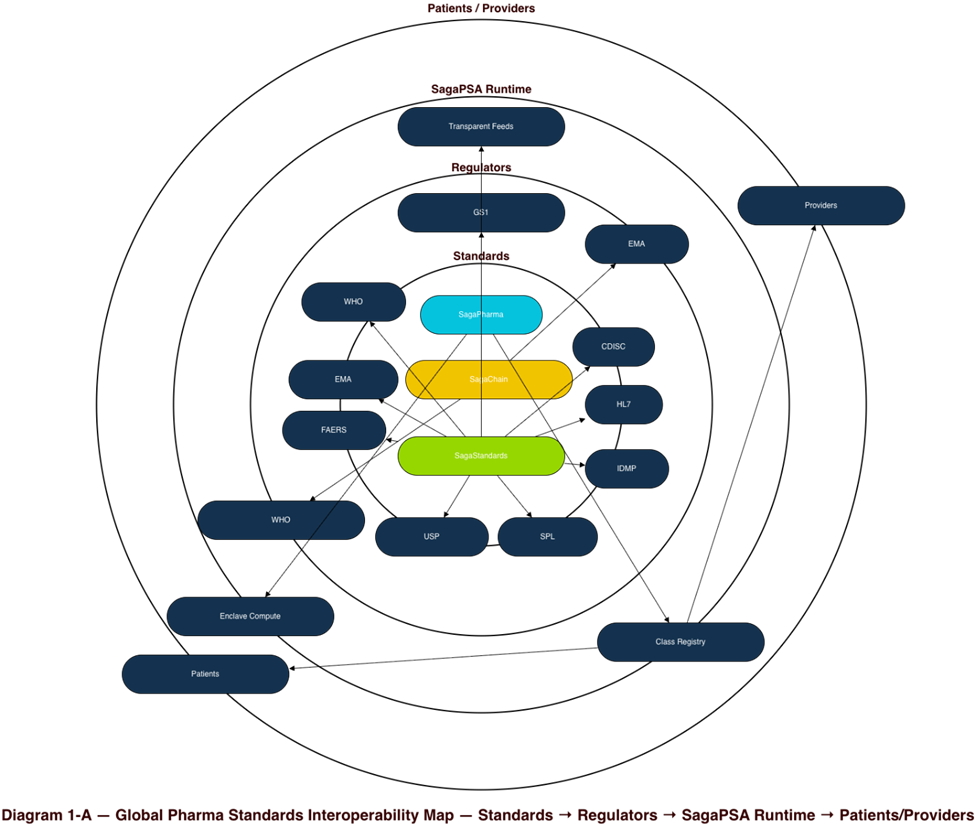
The modern pharmaceutical system rests on a mosaic of standards and regulators that operate independently yet depend on one another. GS1 governs supply chain serialization, CDISC governs clinical data, HL7 governs interoperability, IDMP governs product identification, SPL governs labeling, and the FDA mandates approvals. Regulators such as the EMA, WHO issue parallel requirements. Each framework succeeds within its own domain, yet fragmentation across domains creates inefficiency, opacity, and systemic risk.
1. Introduction
The pharmaceutical sector is at a critical inflection point. Scientific breakthroughs—such as gene therapies, CAR-T cell therapies, and digital therapeutics—are reshaping patient care. At the same time, systemic pressures—including pandemics, supply chain fragility, rising costs, and inequitable access to medicines—are exposing the limitations of existing regulatory, financial, and data infrastructures. Traditional compliance and oversight mechanisms rely on static documents, fragmented reporting, and manual reconciliation, which cannot keep pace with modern global healthcare demands.
Across supply chain serialization, regulatory filings, manufacturing telemetry, pharmacovigilance systems, and patient outcomes, a common challenge persists:
- Fragmentation: Each domain (supply chain, clinical research, regulatory approval, safety monitoring, financial settlements) operates in silos, with minimal interoperability.
- Latency: Critical signals—such as safety alerts, quality deviations, or reimbursement triggers—often take weeks or months to propagate, leaving patients at risk.
- Opacity: Evidence trails are inconsistent, difficult to audit, and often inaccessible to stakeholders, eroding trust in global health systems.
- Inequity: Low- and middle-income countries (LMICs) face persistent barriers to access, as existing infrastructures do not provide verifiable proofs of allocation, safety, and quality.
1.1 Limitations of the Current Ecosystem
Current pharmaceutical governance relies heavily on document-based compliance: regulatory dossiers, structured product labeling (SPL), adverse event reports, quality validation packages, and donor funding agreements are distributed as static files. While standards such as GS1 EPCIS, ISO IDMP, CDISC, HL7 FHIR provide schemas for structuring these datasets, they remain externally referenced artifacts rather than executable, persistent entities.
This creates disconnects: serialized supply chain data does not trigger automated financial settlements; clinical trial results are not seamlessly linked to post-market safety; and equity commitments are reported retrospectively rather than enforced in real time.
Moreover, privacy and confidentiality concerns—including patient health information (PHI), genomic data, and commercial contracts—limit cross-border data sharing. Existing solutions either overexpose sensitive data or fail to provide regulators and payers with sufficient verifiable proofs.
1.2 The SagaChain Approach
SagaChain introduces a fundamentally different paradigm. By encoding global pharmaceutical standards directly into a Universal Class Tree of SagaPSA (Programmable Smart Assets), the system enables:
- Persistence: Data objects—such as clinical trial datasets, EPCIS events, or reimbursement settlements—exist as continuous, stateful entities rather than one-time submissions.
- Interoperability: Standards (GS1, DSCSA, CDISC, HL7, FAERS, WHO VigiBase, etc.) are harmonized within a single inheritance tree, allowing seamless cross-domain linkage.
- Auditability: Every transformation—from raw data ingestion to AI-generated safety signals—is attested with cryptographic proofs, ensuring reproducibility and trust.
- Confidentiality: Enclave computation executes sensitive operations (e.g., genomic analysis, commercial settlement logic) while exposing only compliance proofs and aggregate results.
- Transparency: SagaFeeds™ publish public verified source on labeling, safety signals, equity compliance, and donor-funded allocations, empowering patients, providers, and regulators with verifiable, real-time insights.
1.3 The Role of SagaStandards
This initiative is being advanced under SagaStandards, a division of the PraSaga Foundation dedicated to establishing open, participatory global standards for programmable compliance and interoperability. SagaStandards is not a closed consortium; it is an invitation for collaboration with:
- Regulators: seeking more transparent and verifiable compliance frameworks.
- Industry stakeholders: manufacturers, distributors, payers—seeking harmonized systems that reduce cost and complexity.
- Standards Development Organizations (SDOs): such as GS1, HL7, CDISC, and USP interested in extending their schemas into executable, persistent-state class trees.
- Governments and global health bodies: (WHO, GAVI, national agencies) working toward equity, preparedness, and resilience.
By framing compliance as programmable smart assets rather than static documents, SagaStandards provides the governance structure and collaborative pathway for this Universal Class Tree to be developed as a global public good.
1.4 Toward a Global Pharmaceutical Universal Class Tree
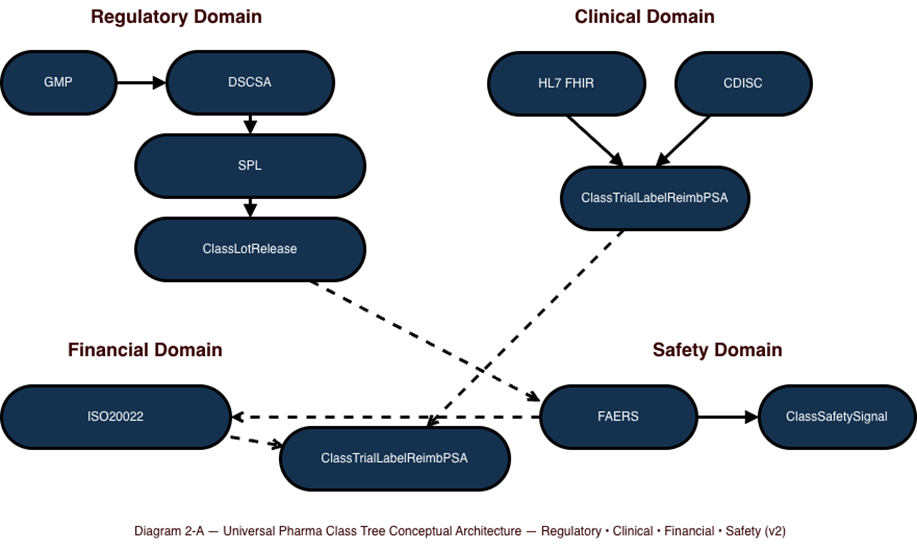
The Universal Class Tree is designed as a multi-inheritable ontology, where regulatory, financial, clinical, and safety objects interconnect seamlessly. For example:
- A lot release object inherits from GMP manufacturing classes, USP assay proofs, DSCSA serialization, and SPL labeling.
- A pharmacovigilance signal object links HL7 patient outcomes, FAERS/EudraVigilance reports, and ISO IDMP product identifiers.
- A donor-funded access asset ties GS1 serialization, WHO treaty obligations, and financial escrow conditions into a verifiable equity framework.
This persistent-state model transforms pharmaceutical compliance from a retrospective, document-heavy burden into a real-time, programmable fabric of trust.
1.5 Structure of this White Paper
This paper is organized into the following major sections:
Section 2: Conceptual Foundations of the Universal Class Tree.
Section 3: Architecture of SagaChain™, SagaPython™, and SagaPSA™.
Section 4: Persistent-State Governance, Privacy, and Enclave Computation.
Section 5: Global Scenario Applications (Scenarios 1–25), illustrating end-to-end use cases across manufacturing, safety, regulatory, financial, and equity contexts.
Section 6: Standards Integration, detailing how SagaChain encodes and harmonizes GS1, HL7, CDISC, USP, WHO, and financial standards.
Section 7: Roadmap and Stakeholder Participation—outlining how SagaStandards enables open collaboration with regulators, payers, industry, and SDOs.
Section 8: Implications for Global Health, Equity, and Innovation.
2. Conceptual Foundations of the Universal Class Tree
Overview
The Universal Class Tree is the conceptual backbone of SagaChain™ and the broader SagaStandards initiative of the PraSaga Foundation. It embodies the principle that global pharmaceutical data, processes, and compliance artifacts must not remain in static documents or siloed systems, but rather exist as persistent, interoperable, and auditable objects within a unified ontology.
By transforming regulatory filings, supply chain events, financial settlements, and pharmacovigilance reports into programmable smart assets, the Universal Class Tree creates a living, continuously updated “evidence graph” for global healthcare. This evidence graph is designed not as a proprietary platform, but as a participatory standard under SagaStandards, open to industry, government agencies, and Standards Development Organizations (SDOs) for collaboration, extension, and adoption.
2.1 From Static Standards to Executable Objects
Traditional standards—such as GS1 EPCIS (supply chain events), ISO IDMP (product identification), CDISC SDTM (clinical data), HL7 FHIR (EHR interoperability), and FAERS/MedDRA (safety reporting)—provide schemas and reference models. Yet in practice, these standards are implemented inconsistently, exchanged as documents, and rarely integrated in real time.
The Universal Class Tree reinterprets these schemas as SagaPSA™ (Programmable Smart Asset) classes within SagaPython™:
- GS1/DSCSA: serialized units become objects linked to manufacturing batches, SPL labels, and reimbursement flows.
- CDISC/HL7: trial data becomes executable classes tied directly to labeling updates and payer reimbursement decisions.
- Safety events: (FAERS, EudraVigilance, WHO VigiBase) become persistent pharmacovigilance objects cross-linked to product identifiers, clinical outcomes, and recall events.
This objectification transforms standards from passive references into active, stateful participants in compliance and oversight.
2.2 Multi-Inheritance and Ontology Design
Most blockchains provide a transaction virtual machine but lack an operating system for managing persistent objects, namespaces, versioning, account negotiation, and message passing as primitive operations. SagaOS™ addresses this deficiency as the on-chain operating system of SagaChain™, ensuring that every standard class (e.g., ISO 20022, FIX, XBRL) and regulatory class (e.g., SEC, FRB, OCC) resides in a canonical runtime with uniform execution semantics.
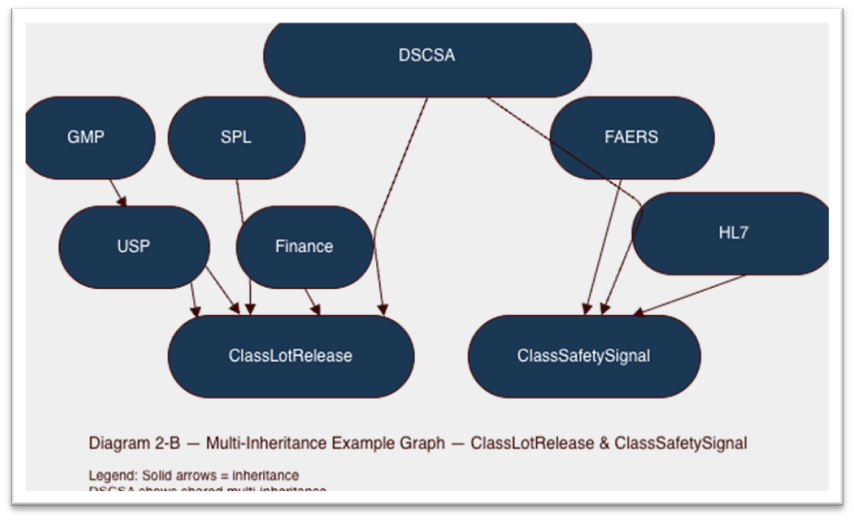
The Universal Class Tree is structured as a multi-inheritable ontology. Each class can inherit attributes and methods from multiple domains, reflecting the interconnected nature of pharmaceutical compliance.
For example:
- A ClassLotRelease object may inherit from:
- Manufacturing (GMP/USP assays)
- Supply chain (GS1/DSCSA serialization, EPCIS events)
- Regulatory (SPL labeling, IDMP identifiers)
- Finance (financial settlement conditions)
- A ClassSafetySignal may inherit from:
- Pharmacovigilance systems (FAERS, EudraVigilance, VigiBase)
- Clinical outcomes (HL7 FHIR, CDISC trial data)
- Supply chain provenance (GS1 identifiers, DSCSA units)
Through this ontology, disparate domains are reconciled into a cohesive, executable framework, enabling seamless propagation of compliance across the pharmaceutical lifecycle.
Architecture of SagaChain™, SagaPython, and SagaPSA™ (Pharma Edition, under SagaStandards)
Overview
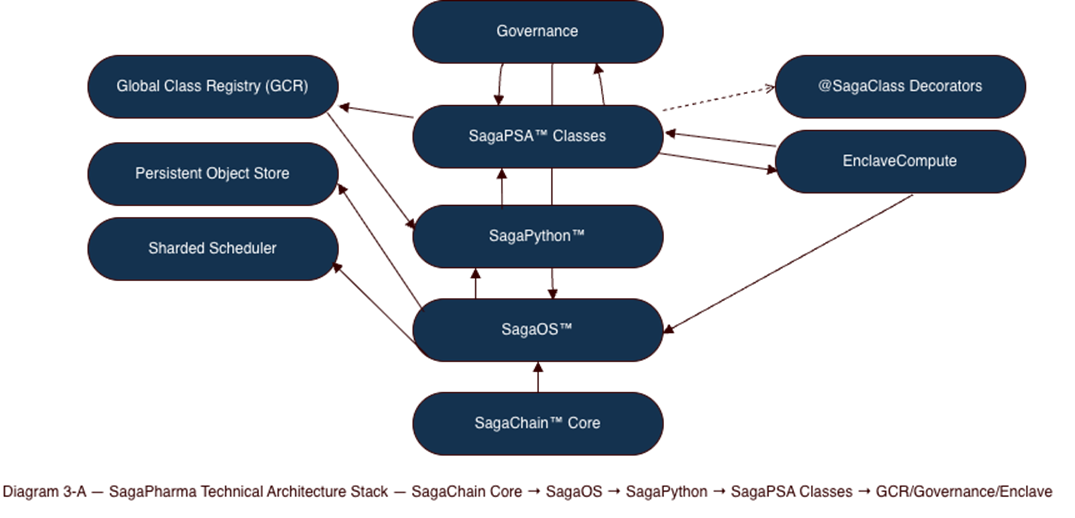
This chapter adapts the foundational elements of SagaChain to the requirements of a single-instance global pharmaceutical class tree, governed as an open, participatory standard under SagaStandards (PraSaga Foundation). It delineates how SagaChain transforms regulatory frameworks and healthcare standards into persistent, multi-inheritable objects; elucidates the structural distinctions from first-generation blockchains and conventional middleware; and outlines mechanisms for industry, government, and standards development organizations (SDOs) to co-author and extend the technology stack.
3.1 SagaPython: Native Language for Persistent Pharma Classes
SagaPython™ constitutes a dialect of Python tailored for persistent, compliance-oriented execution on SagaChain. It retains Python’s accessibility while incorporating chain-native semantics via the Class Manager Infrastructure (CMI) and policy hooks consonant with SagaStandards governance.
3.1.1 Innovations in SagaPython for Pharma
Persistent Classes: The @SagaClass(<AncestorA>, <AncestorB>, …) decorator designates classes that persist across blocks, shards, and versions.
Validated Fields: SagaField(“<field_name>”, “<type>”) enforces types, enums, patterns, ranges, and lengths, with validation occurring at class load and pre-commit.
Behavioral Methods: The @SagaMethod() decorator declares lifecycle methods equipped with pre- and post-compliance hooks.
Multi-Inheritance: Classes inherit across domains such as GS1, DSCSA, HL7, CDISC, ISO IDMP, SPL, FAERS, and EMA, with ancestors defined prior to subclasses.
Late Binding: Method resolution occurs dynamically across the class tree, facilitating additive evolution without disrupting lineage.
Enclave Execution: Classes or methods may be flagged for confidential compute (via policy), with outputs limited to selective proofs.
3.1.2 Example: Evidence-Linked Label Section
from CMIConst import SPClassObject

@SagaClass(SPClassObject)
class ClassSPLSection:
 SagaField("spl_id", "str")
 SagaField("section_code", "str") # enum={"INDICATIONS","DOSAGE","WARNINGS","CLINICAL_STUDIES"}
 SagaField("text", "str")
 SagaField("evidence_oids", "list") # CDISC/HL7/Trial object OIDs
 SagaField("version", "str")

 @SagaMethod()
 def __init__(self, spl_id: str, section_code: str, text: str, evidence_oids: list, version: str):
 self._cmi().__init__() # Chain to SPClassObject
 self.spl_id = spl_id
 self.section_code = section_code
 self.text = text
 self.evidence_oids = evidence_oids
 self.version = version
 self.docs = [] # Default documentation array
 self._enclave = {} # Mock enclave storage

 @SagaMethod()
 def validate(self):
 assert len(self.evidence_oids) > 0, "SPL section must cite evidence objects"
 return True
Code language: Python (python)
This formulation enables industry participants to leverage Python proficiency; affords regulators compliance-by-design; and permits SDOs to operationalize schemas as executable code rather than static documents.
3.2 SagaOS: The On-Chain Operating System for Healthcare
3.2.1 Role in the Stack
Few distributed ledgers furnish an operating system that administers persistent objects, namespaces, versioning, scheduling, policy hooks, and message passing as primitive capabilities. SagaOS functions as the distributed kernel, ensuring that every standard class—encompassing ISO 20022, GS1 EPCIS, HL7 FHIR, CDISC, SPL, FAERS/EudraVigilance—executes within a singular canonical runtime, upholding uniform semantics under SagaStandards governance.
3.2.2 Core Subsystems
- Global Class Registry (GCR): A canonical catalog of all @SagaClass definitions, mitigating schema drift and preserving version lineage.
- Persistent Object Store (POS): Durable repository for instances, addressable via globally unique Object IDs (OIDs).
- Deterministic Message Bus (DMB): Facilitates causal, replayable invocations between objects’ @SagaMethod() via OIDs.
- SagaScale (SS): Allocates and migrates objects by affinity and locality (see§3.6).
- Version & Policy Manager (VPM): Oversees evolution and attaches regulator checks pre- and post-method execution.
3.2.3 Example: OS-Level Process & Signals for GxP Workflow
SagaPython™ classes replace ad hoc tags with typed fields:
from CMIConst import SPClassObject

@SagaClass(SPClassObject)
class ClassOSProcess:
 SagaField("pid", "str")
 SagaField("owner_oid", "str")
 SagaField("state", "str") # enum={"Running","Suspended","Completed"}
 SagaField("tags", "dict") # {"GxP": "211", "validation": "IQ/OQ/PQ"}

 @SagaMethod()
 def __init__(self, pid: str, owner_oid: str, tags: dict = None):
 self._cmi().__init__() # Chain to SPClassObject
 self.pid = pid
 self.owner_oid = owner_oid
 self.state = "Running"
 self.tags = tags or {}
 self.docs = []
 self._enclave = {}

 @SagaMethod()
 def send_signal(self, signal: str):
 assert signal in {"SUSPEND","RESUME","STOP"}
 self.state = {"SUSPEND":"Suspended","RESUME":"Running","STOP":"Completed"}[signal]
 return self.state
Code language: Python (python)
(image)
3.3 SagaPSA™: Programmable Smart Assets (Beyond “Contracts”)
3.3.1 Concept
A SagaPSA denotes a long-lived healthcare object capable of inheriting concurrently from multiple standards and regulatory classes. The object embodies the full lifecycle—from manufacturing through serialization, labeling, safety surveillance, to reimbursement—eschewing brittle extract-transform-load (ETL) processes.
3.3.2 Invariants, Lifecycle, Policy Hooks
- Invariants: Implemented via SagaField constraints and @SagaMethod checks.
- Lifecycle: Domain-specific actions (e.g., commission_sgtins(), release_lot(), update_label(), settle_payment()) mutate the object while maintaining cryptographic lineage.
- Policy Hooks: The VPM affixes regulator validations atomically to business logic (e.g., requiring USP proof prior to SGTIN commissioning).
3.3.3 Example: Trial→Label→Reimbursement PSA
from CMIConst import SPClassObject

@SagaClass(SPClassObject)
class ClassTrialLabelReimbPSA:
 SagaField("status", "str") # enum={"Collecting","Analyzing","Labeled","Reimbursed"}
 SagaField("analysis_datasets", "list")
 SagaField("section_code", "str") # enum={"CLINICAL_STUDIES"}
 SagaField("sender", "str", optional=True)
 SagaField("receiver", "str", optional=True)
 SagaField("currency", "str", optional=True, length=3)
 SagaField("amount", "int", optional=True) # Minor units, integer only

 @SagaMethod()
 def __init__(self, analysis_datasets: list, section_code: str):
 self._cmi().__init__() # Chain to SPClassObject
 self.status = "Collecting"
 self.analysis_datasets = analysis_datasets
 self.section_code = section_code
 self.docs = []
 self._enclave = {}

 @SagaMethod()
 def publish_label(self):
 assert len(self.analysis_datasets) > 0
 self.status = "Labeled"
 return self.status

 @SagaMethod()
 def trigger_reimbursement(self, payer: str, payee: str, ccy: str="USD", amount: int=100): # Minor units
 assert self.status == "Labeled"
 self.sender = payer
 self.receiver = payee
 self.currency = ccy
 self.amount = amount
 self.status = "Reimbursed"
 return self.amount

 def _derive_amount_from_outcomes(self) -> int:
 # Placeholder deterministic rule in minor units
 return 100
Code language: Python (python)
3.4 Global Single-Instance Pharma Class Tree
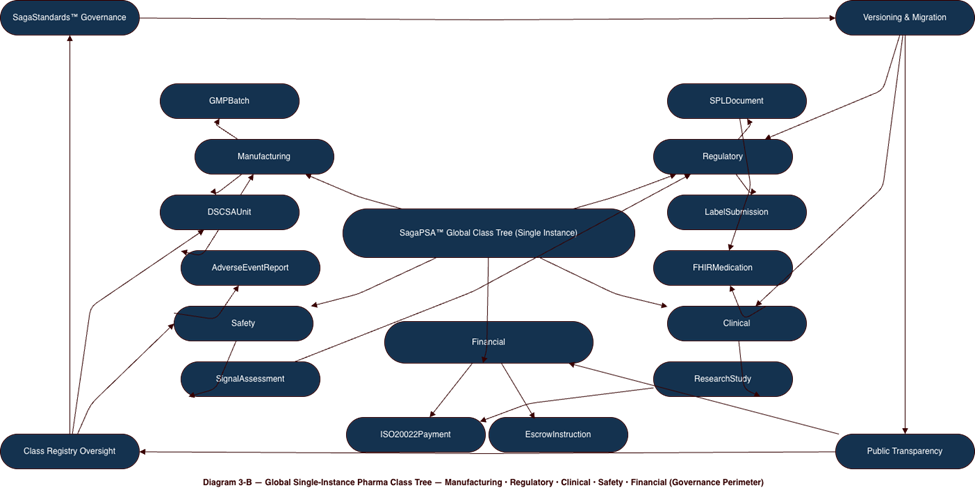
A foundational tenet of SagaChain™ resides in its Global Single-Instance Class Tree—a canonical namespace wherein every regulatory, clinical, supply chain, safety, and financial class manifests once and inherits uniformly across applications. This paradigm obviates the protracted challenge of schema proliferation and vendor-specific divergences (e.g., FDA SPL, EMA IDMP, USP monographs, GS1 EPCIS). Instead, each lifecycle entity—from preclinical study objects to biosimilar records—inherits from this unified tree, with explicit version lineage and cryptographic auditability.
3.4.1 Canonical Namespace and Versioned Evolution
- All classes (e.g., ClassSPLDocument, ClassDSCSAUnit, ClassFAERSReport) register in the GCR.
- Conflicts resolve through versioned inheritance, not divergence; for instance, SPL_v2 extends SPL_v1 additively.
- Under SagaStandards governance, modifications proceed via structured class diffs, subject to review by regulators, SDOs, and industry stakeholders.
3.4.2 Pharma-Specific Example: Lot Release
The lot release process, conventionally fragmented across GMP batch records, USP assays, DSCSA serialization, and SPL labeling, coalesces into a singular persistent object on SagaChain:
from CMIConst import SPClassObject
from ClassFungibleAsset import ClassFungibleAsset # Assuming prior definition

@SagaClass(ClassFungibleAsset, SPClassObject)
class ClassLotRelease:
 SagaField("lot_id", "str")
 SagaField("product_id", "str") # ISO IDMP identifier
 SagaField("gmp_batch_ref", "str")
 SagaField("usp_assay_proofs", "list") # Enclave-generated QC results
 SagaField("dsccsa_units", "list") # Serialized unit references
 SagaField("spl_ref", "str") # Structured product labeling link
 SagaField("release_status", "str") # enum={"Pending","Released","Quarantined"}

 @SagaMethod()
 def __init__(self, lot_id: str, product_id: str, gmp_batch_ref: str):
 self._cmi('ClassFungibleAsset').__init__() # Chain to ClassFungibleAsset
 self._cmi().__init__() # Chain to SPClassObject
 self.lot_id = lot_id
 self.product_id = product_id
 self.gmp_batch_ref = gmp_batch_ref
 self.usp_assay_proofs = []
 self.dsccsa_units = []
 self.spl_ref = ""
 self.release_status = "Pending"
 self.docs = []
 self._enclave = {}

 @SagaMethod()
 def approve_release(self):
 assert self.usp_assay_proofs and self.dsccsa_units and self.spl_ref
 self.release_status = "Released"
 return self.release_status

 @SagaMethod()
 def enclaveSet(self, key: str, value: str):
 self._enclave[key] = value
 return self._enclave[key]

 @SagaMethod()
 def enclaveGet(self, key: str):
 return self._enclave.get(key)
Code language: Python (python)
Here, the lot release object encapsulates the lifecycle: assay results, serialization, labeling, and approval embed within one auditable class.
3.4.3 Governance Under SagaStandards
Industry participation: Manufacturers propose attributes (e.g., cold-chain telemetry types).
- Industry participation: Manufacturers propose attributes (e.g., cold-chain telemetry types).
- Regulators: FDA, EMA, WHO validate changes within the governance framework.
- SDOs: USP, GS1, HL7, CDISC ensure schema fidelity as executable classes.
- Version lineage: Changes prioritize backward compatibility; disruptions yield versioned subclasses (e.g., ClassLotRelease_v2).
3.4.4 Implications
- For Industry: Schema reconciliation costs diminish; a unified definition propagates globally.
- For Regulators: Audit trails auto-preserve; objects trace lineage to originating classes.
- For Standards Bodies: Specifications evolve from inert documents to dynamic, executable code in a shared runtime.
- For Patients: Enhanced safety and expedited medicine access via real-time, verifiable compliance.
Section 3.4 Summary:
The Global Single-Instance Pharma Class Tree reconceptualizes compliance as a shared, executable ontology, ameliorating schema duplication and latency. By integrating GMP, USP, DSCSA, SPL, and IDMP into a canonical namespace, SagaChain lays the groundwork for perpetual, interoperable pharmaceutical assurance.
3.5 Governance and SagaStandards Participation
A pivotal distinction of SagaChain™ lies in its integration of technical runtime with participatory governance under SagaStandards, the PraSaga Foundation’s standards division. In contrast to blockchain systems reliant on ad-hoc proposals or token-based voting, SagaChain aligns with SDOs, regulators, and consortia structures, rendering governance institutional, collaborative, and inherently auditable.
3.5.1 Role of SagaStandards
SagaStandards stewards the evolution of the Global Pharmaceutical Universal Class Tree, furnishing:
- Membership and Working Groups: Open access for regulators, manufacturers, SDOs (e.g., ISO, GS1, HL7, CDISC, USP), and payers.
- Namespace Stewardship: Domains (e.g., ISO 20022, GS1 EPCIS, HL7 FHIR, USP) reside in segregated namespaces within the GCR, curated by pertinent SDOs or regulators.
- Change Proposal Workflow: Novel classes, fields, or methods enter via formal class diffs, deliberated in working groups, and ratified for GCR inclusion.
- Compliance Alignment: Digital class definitions map precisely to regulatory and industry standards, forestalling divergence between specifications and code.
3.5.2 Governance Workflow
Updates to the Universal Class Tree adhere to a transparent, multi-stakeholder process:
- Proposal Submission: SagaStandards members (industry, regulators, SDOs, observers) tender new classes, fields, or decorator rules.
- Working Group Review: Proposals route to domain-specific groups (e.g., Pharmacovigilance WG, Supply Chain WG) for technical and regulatory scrutiny.
- Public Transparency via SagaFeeds™: Pending proposals index as discoverable on-chain objects, enabling oversight by regulators, academics, and the public.
- Consensus & Ratification: Domain stewards vote; ratified alterations integrate into the GCR.
- Versioning and Migration: Changes favor additivity; disruptions spawn versioned subclasses (e.g., ClassDSCSAUnit_v2) with defined migration methods.
This workflow supplants informal advocacy and opaque revisions with auditable, participatory mechanisms.
3.5.3 Policy Principles
SagaStandards governance upholds inviolable tenets:
- Additive-First Evolution: Modifications extend functionality sans invalidating extant objects.
- Explicit Migration: Inevitable disruptions mandate intra-class migration hooks.
- Namespace Integrity: Classes uniquely occupy namespace-version pairs; conflicts yield versioned lineages, not replicas.
- Public Transparency: SagaFeeds™ render proposals, commentary, and ratifications immutable and globally accessible.
3.5.4 Industry & Regulator Benefits
- Industry: Assured encoding of compliance in the Universal Class Tree curtails integration expenses and interpretive variance.
- Regulators: Direct stewardship of domains (e.g., FDA for SPL, EMA for EudraVigilance) with preserved lineage for audits.
- SDOs: Canonical, executable representations of specifications at scale.
- LMICs & Global Health Bodies: Open participation yields immediate compliance visibility, sans proprietary encumbrances.
3.5.5 Example Governance Use Case
from CMIConst import SPClassObject

@SagaClass(SPClassObject)
class ClassGovernanceProposal:
 SagaField("proposal_id", "str")
 SagaField("namespace", "str") # e.g., "HL7.FHIR.Medication"
 SagaField("proposer", "str") # Member ID or regulator account
 SagaField("change_type", "str") # additive, breaking, migration
 SagaField("diff_summary", "str") # Human-readable description
 SagaField("status", "str") # enum={"Submitted","Reviewed","Ratified","Rejected"}

 @SagaMethod()
 def __init__(self, proposal_id: str, namespace: str, proposer: str, change_type: str, diff_summary: str):
 self._cmi().__init__() # Chain to SPClassObject
 self.proposal_id = proposal_id
 self.namespace = namespace
 self.proposer = proposer
 self.change_type = change_type
 self.diff_summary = diff_summary
 self.status = "Submitted"
 self.docs = []
 self._enclave = {}

 @SagaMethod()
 def advance_status(self, new_status: str):
 assert new_status in {"Reviewed","Ratified","Rejected"}
 self.status = new_status
 return self.status
Code language: Python (python)
3.6 SagaInterop – Cross-Chain Interoperability
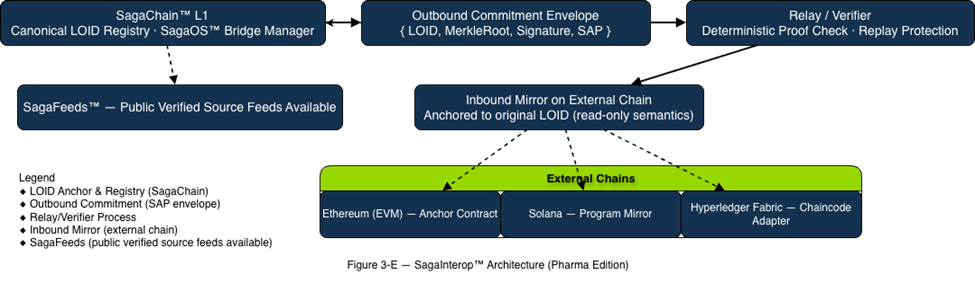
SagaInterop™ is the SagaChain™ subsystem that enables deterministic, auditable message and state exchange between SagaChain and external blockchain networks (both public and enterprise). It provides a programmable bridge layer that preserves on-chain provenance, digital signatures, and object semantics across heterogeneous runtimes.
3.6.1 Architecture
Cross-Domain Class Mirroring: SagaPython classes can be declared as interoperable using the @SagaInteropClass() decorator, defining serialization and verification schemas for external networks such as Ethereum, Hyperledger Fabric, or Solana.
- Bridge Anchors: Each participating chain hosts a lightweight anchor contract that stores the cryptographic commitment of the SagaChain LOID, plus Merkle-proof links to the original SagaPSA™ (Class/Method/Field) transaction.
- State Attestation Protocol (SAP): A standardized, ISO 20022-aligned envelope (
<SagaInteropSAP>) carries state attestation, timestamp, jurisdiction tag, and proof hash. SAPs are routed via SagaScale™ L2L gossip for settlement ordering. - Bidirectional Invocation: Authorized nodes can execute verified cross-chain calls through the SagaOS™ Bridge Manager, which enforces gas reconciliation, event replay protection, and LOID-based message idempotency.
- Public–Private Boundary Control: Enclave and non-enclave accounts can both issue cross-chain events; enclave proofs remain opaque but verifiable through their attestation references.
3.6.2 Standards Alignment
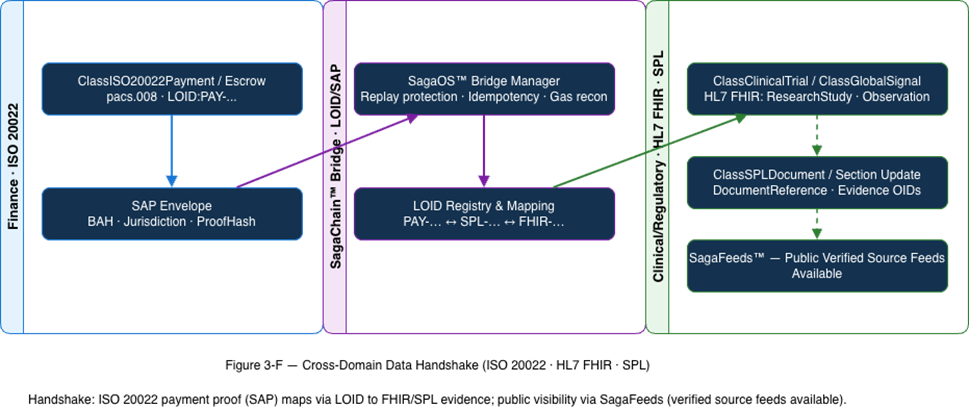
- ISO 20022 Business Application Header for message typing and jurisdictional routing.
- HL7 FHIR “Bundle/DocumentReference” templates for clinical or pharmacovigilance data payloads.
- W3C Verifiable Credential signatures for off-chain attestations.
- GS1 Digital Link URI for physical-to-digital serialization.
3.6.3 Benefits
- Enables regulated interoperability between public token networks and permissioned data enclaves.
- Preserves LOID traceability across jurisdictions, ensuring object lineage even when mirrored on external blockchains.
- Provides common semantic interoperability across industries (finance, pharma, ESG) using SagaStandards™.
- Reduces reconciliation latency by embedding cross-chain confirmations directly into the SagaChain transaction log.
3.6.4 Example Usage
A WHO-affiliated account posts a pharmacovigilance signal to an EU EMA ledger and an ISO 20022 financial escrow chain simultaneously.
The attestation payload references the same SagaPSA ClassGlobalSignal LOID, ensuring every jurisdiction shares a provably identical event record.
Persistent-State Governance, Privacy, and Enclave Computation
Overview
SagaChain effectuates persistent-state governance, privacy-by-design, and enclave computation to underpin pharmaceutical compliance at global scale. This framework supplants document-centric oversight with executable classes under SagaStandards, augmented by confidential compute that safeguards privacy while furnishing verifiable accountability.
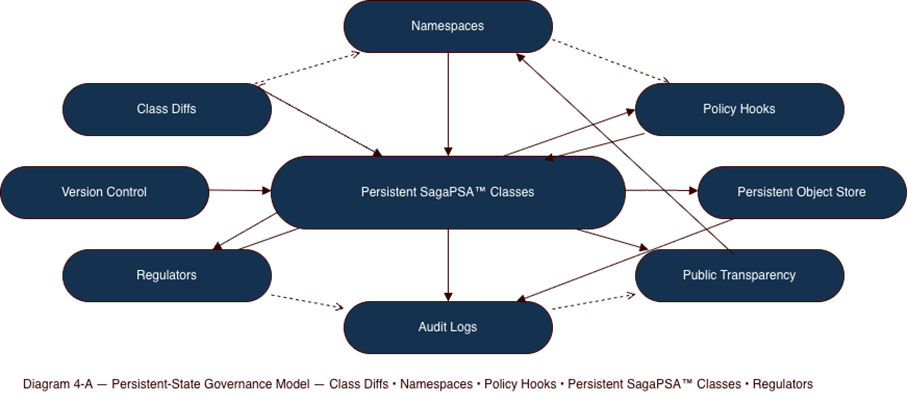
4.1 Persistent-State Governance: From Documents to Executable Classes
Conventional pharmaceutical governance hinges on documents—PDF dossiers, submissions, validation reports, and adverse event compendia—which prove retrospective, curated manually, and decoupled from operations.
SagaChain supplants this with persistent-state classes governed via SagaStandards. Each standard or regulatory mandate manifests as an @SagaClass definition, stewarded by SDOs, regulators, and industry in a multi-stakeholder framework.
Governance Features:
- Canonical Namespace: Classes (e.g., FDA SPL, EMA IDMP, GS1 EPCIS, USP assay) reside uniquely in the GCR.
- Version Lineage: Updates engender subclasses (_v2, _v3) inheriting from antecedents, preserving compatibility.
- Change Proposals: Stakeholders tender schema updates as class diffs; adoption follows consensus and voting.
- Compliance Hooks: Policy logic affixes to @SagaMethod invocations (e.g., release(), recall(), settle()), embedding regulatory validations inline.
4.2 Privacy-by-Design and Confidential Computation
Conventional blockchains render data public, antithetical to pharmaceutical exigencies involving patient health information (PHI), genomic datasets, proprietary telemetry, and contracts. Regulators and payers, however, demand compliance proofs.
SagaChain addresses this via privacy-by-design, where enclave owners can run SagaNode on TEE-based equipment providing hardware and runtime-level assurances.
Key Features:
- Encrypted-in-Use: Sensitive inputs process encrypted, countering insider and external threats.
- Deterministic Compute: Enclaves execute algorithms (e.g., safety signal detection, potency assays) yielding reproducible outputs for regulatory fidelity.
- Selective Disclosure: Enclaves emit proofs, aggregates, or attestations (e.g., “batch potency verified against USP standard”), shielding raw data.
- Audit Compatibility: Outputs bear cryptographic signatures, permitting regulator audits sans raw access.
- zK Integration: Enclave attestations augment with zero-knowledge proofs for jurisdiction-agnostic verification.
This TEE-zk hybrid yields a compliance paradigm that is privacy-preserving yet globally auditable.
4.3 Example Enclave Workflow in SagaPython
SagaPython expresses confidential workflows natively via CMI decorators. A pharmacovigilance workflow exemplifies:
from CMIConst import SPClassObject

@SagaClass(SPClassObject)
class ClassPHIRecord:
 SagaField("record_id", "str")
 SagaField("patient_id", "str")
 SagaField("encrypted_payload", "bytes") # HL7 FHIR data encrypted
 SagaField("enclave_proof", "str", optional=True)

 @SagaMethod()
 def __init__(self, record_id: str, patient_id: str, encrypted_payload: bytes):
 self._cmi().__init__() # Chain to SPClassObject
 self.record_id = record_id
 self.patient_id = patient_id
 self.encrypted_payload = encrypted_payload
 self.enclave_proof = ""
 self.docs = []
 self._enclave = {}

@SagaClass(SPClassObject)
class ClassEnclaveAdverseEventAnalysis:
 SagaField("analysis_id", "str")
 SagaField("input_records", "list") # References to ClassPHIRecord
 SagaField("medDRA_code", "str", optional=True)
 SagaField("risk_score", "float", optional=True)
 SagaField("enclave_attestation", "str", optional=True)

 @SagaMethod()
 def __init__(self, analysis_id: str, input_records: list):
 self._cmi().__init__() # Chain to SPClassObject
 self.analysis_id = analysis_id
 self.input_records = input_records
 self.medDRA_code = ""
 self.risk_score = 0.0
 self.enclave_attestation = ""
 self.docs = []
 self._enclave = {}

 @SagaMethod()
 def detect_signal(self):
 # Executes AI/ML in enclave; no raw PHI egresses
 self.medDRA_code = "10012345" # MedDRA code
 self.risk_score = 0.87 # Probability
 self.enclave_attestation = "attest:sha256:..."
 return self.risk_score
Code language: Python (python)
Implications:
- Regulators (FDA, EMA, WHO): Standardized signals with lineage, absent raw PHI.
- Providers: Reporting sans patient exposure.
- Patients: HIPAA/GDPR safeguards amid safety contributions.
- Industry: Proprietary models execute privately, preserving IP.

4.4 Governance Alignment with Global Standards
Governance underpins adoption. SagaChain anchors this in SagaStandards, encompassing industry, regulators, SDOs, and agencies.
4.4.1 Alignment Mechanisms:
- Namespace Stewardship:
- FDA curates SPL classes.
- EMA oversees IDMP namespaces.
- WHO manages pharmacovigilance and treaty classes.
- Participatory Model:
- Diff-based proposals for classes or changes.
- Transparent workflows prioritize additivity; disruptions version subclasses.
- Executable Specifications:
- SDOs publish classes as live GCR entries, supplanting PDFs.
- USP monographs enforce as @SagaMethod compliance.
- Continuous Oversight:
- Regulators subscribe to SagaFeeds™ for assurance (e.g., MedDRA events in prior 7 days).
This elevates governance from periodic, document-bound submissions to perpetual, shared code stewardship.
4.5 Patient, Provider, and Payer Trust
Trust spans stakeholders via enclave confidentiality and transparent indices:
This model triangulates trust: patient empowerment bottom-up, regulator assurance top-down.
- Patients: PHI privacy with transparency into safety, labeling, allocation
- Example: GS1 Digital Link scan verifies SPL, leaflets, cold-chain proofs sans identity revelation.
- Providers: Synchronized SPL, FAERS/EudraVigilance, dosing in EHR (HL7 FHIR), error mitigation.
- Payers & Donors: Funds release on verified proofs (e.g., GAVI confirms LMIC delivery via SagaFeeds™).
- Regulators: Cryptographic proofs and indices supplant delayed reports; enclaves assure computations.
- This model triangulates trust: patient empowerment bottom-up, regulator assurance top-down.
4.6 Implications for Global Adoption
SagaChain’s governance and privacy extend ecosystem-wide:
- Industry: Dossier resubmissions yield to persistent objects; quality, pharmacovigilance, reimbursement streamline.
- Regulators: Episodic audits evolve to continuous attestations.
- SDOs: Standards as executable ontologies (GS1, ISO, CDISC, HL7, USP, WHO).
- Global Health Equity: LMICs access dashboards and proofs equitably, sans proprietary costs; donor programs verifiable.
- Finance & Sustainability: ESG, risk pools, ISO 20022 settlements tie to proofs, rendering accountability programmable.
4.7 Governance Workflows in SagaStandards
SagaChain operationalizes governance as continuous workflow under SagaStandards, transcending static standardization.
Workflow Model:
- Proposal Submission
Stakeholders propose definitions or modifications (e.g., ClassClinicalTrial_v2 extending CDISC SDTM v1.4) as GCR diffs. - Stakeholder Review
Domain stewards (FDA for SPL, EMA for IDMP, GS1 for serialization, WHO for health) scrutinize publicly. - Consensus & Ratification
Additive evolution defaults; disruptions version with hooks (ClassDrugProduct_v3). - Activation & Monitoring
Ratified classes activate in GCR; metrics and attestations auto-track. - Sunset & Deprecation
Legacy classes persist for audits, marked deprecated; migrations guide adoption.
Implications:
- Industry: Transparent versioning curtails forks, interoperability failures.
- Regulators: Direct class oversight enforces boundary compliance.
- SDOs: Standards as live governance objects.
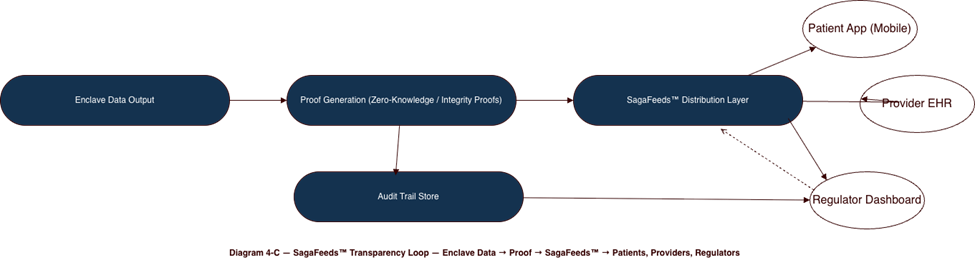
4.8 Regulatory Auditing via SagaFeeds™
Audits shift from manual dossiers to continuous SagaFeeds™ automation.
Core Principles:
- Reads: Listeners can be configured for object inquirer has authorization to access.
- Append-Only Transparency: Immutable OID lists for lineage.
- Composable Feeds: Dynamic aggregates (e.g., “SPL updates for IDMP product X, 90 days”).
- No PHI Leakage: References and proofs only; payloads enclave-bound.
Use Cases:
- Pharmacovigilance: Feeds of adverse events by IDMP.
- Supply Chain: EPCIS events for DSCSA diversion detection.
- Financial: ISO 20022 disbursements on delivery proofs.
- Labeling: Joint FDA/EMA SPL feeds for synchronization.
Implications:
- Equity: LMIC parity in capabilities.
- Real-Time: Live proofs supplant annual submissions.
- Audit Trails: State reconstruction at any epoch.
4.9 Patient and Provider Interfaces
Trust engages patients and providers via SagaFeeds™-based interfaces.
Patient Interfaces:
- GS1 Digital Link Scans: QR resolution to SPL, leaflets, proofs.
- Safety Alerts: Real-time signals; batch recall checks.
- Equity Dashboards: Delivery proofs for LMIC reassurance.
Provider Interfaces:
- EHR Integration (HL7 FHIR): SPL, USP guidelines, pharmacogenomics in workflows.
- Quality Verification: GMP proofs, assays, serialization pre-administration.
- Pharmacovigilance: Enclave-protected reporting to attested signals.
Implications:
- Patients: Visibility, agency beyond institutions.
- Providers: Point-of-care compliance, outcome enhancement.
- Public Health: Feedback loops among patients, providers, regulators.
Section 4 Summary:
SagaChain redefines pharmaceutical governance and privacy. SagaStandards stewardship, enclave computation, and SagaFeeds™ transparency equilibrate confidentiality, accountability, and interoperability, enabling shared trust fabric.
SagaStandards workflows govern class evolution; SagaFeeds™ enable real-time auditing; patient/provider interfaces operationalize trust. These forge episodic, paper-bound governance into continuous, transparent, participatory global health infrastructure.
5. Cross-Cutting Interoperability Scenarios
Under construction
Coming soon…
Under construction
Coming soon…
6. Regulatory Subtrees and Global Standards Integration
Under construction
Coming soon…
Under construction
Coming soon…
7. Integration with Global Standards & Regulatory Frameworks
Under construction
Coming soon…
Under construction
Coming soon…
8. Roadmap and Stakeholder Participation
Under construction
Coming soon…
Under construction
Coming soon…
9. Implications for Global Health, Equity, and Innovation
Under construction
Coming soon…
Under construction
Coming soon…
Appendices
Under construction
Coming soon…
Under construction
Coming soon…